Loading the question bank
Lorry and bus · DVSA-based revision questions
Vehicle weights and dimensions
76 LGV and PCV theory test questions on vehicle weights and dimensions. Preview the questions below, or open one to read its answer and continue through the whole topic.
Practise
Be marked as you go
A session draws from all 76 of these, weakest first, and marks each answer the moment you give it. Nothing here needs an account.
The questions
20 of 76The first 20 in the order the pack holds them. Open the answer when you want to check yourself; a session draws from all 76 and marks you instead.
What does this road sign mean?
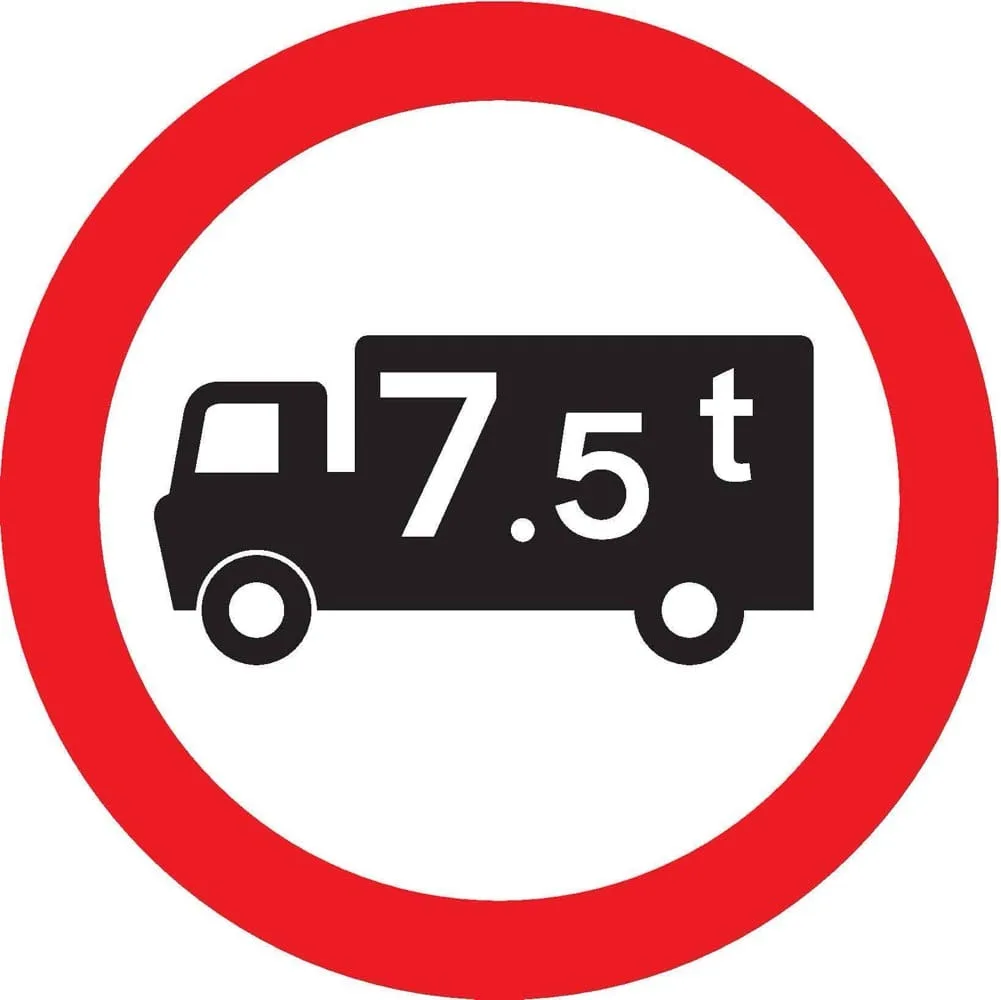
No goods vehicles under 7.5 tonnes maximum authorised mass
No goods vehicles over 7.5 tonnes maximum authorised mass
No goods vehicles over 7.5 metres overall height
No goods vehicles under 7.5 metres overall height
Show the answer
No goods vehicles over 7.5 tonnes maximum authorised massThis was the right answer
It's essential that all limits are complied with to avoid breaking the law and facing possible prosecution. Weight restrictions normally apply to the plated weight of a vehicle, often referred to as the maximum authorised mass (MAM).
What does this temporary sign mean for drivers of vehicles over 7.5 tonnes maximum authorised mass?
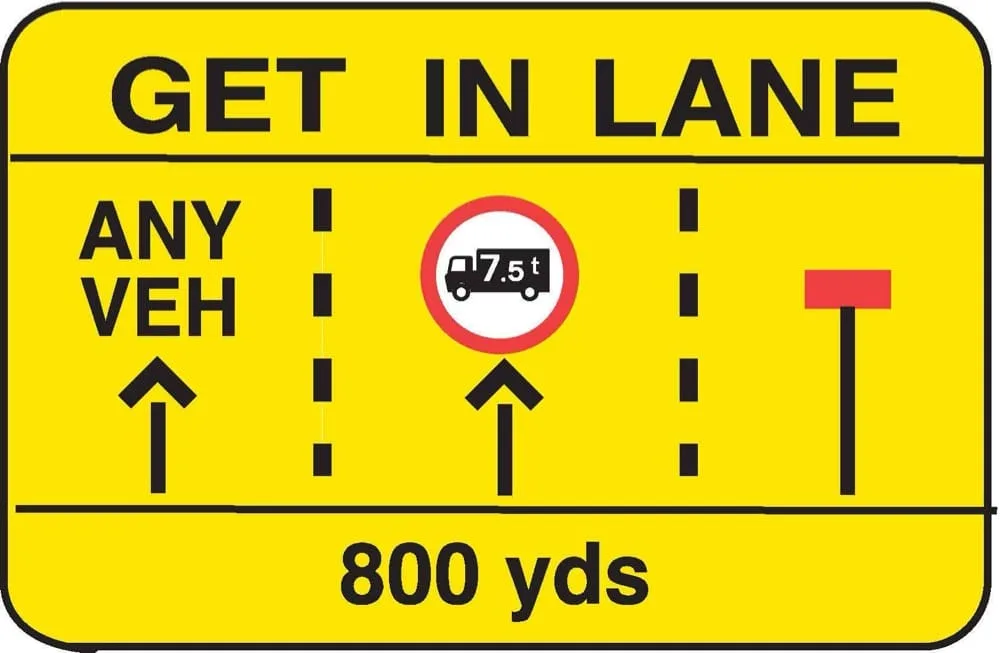
Use either the left-hand or middle lane
Use only the left-hand lane
Use only the middle lane
Use any lane
Show the answer
Use only the left-hand laneThis was the right answer
Lanes at roadworks often have weight restrictions to keep larger vehicles in the left-hand lane. The lanes through the roadworks are often narrow and therefore not wide enough for large vehicles to pass each other safely.
Always look for restriction signs at roadworks. They're usually placed well in advance to give you time to move safely into the correct lane in good time.
In England and Wales, what's the national speed limit on a single carriageway road for a rigid lorry with a maximum authorised mass of more than 7.5 tonnes?
30 mph
40 mph
50 mph
60 mph
Show the answer
50 mphThis was the right answer
In England and Wales, vehicles exceeding 7.5 tonnes maximum authorised mass are restricted to a maximum of 50 mph on single carriageway roads. In Scotland, this speed limit is 40 mph.
You're driving a lorry with a maximum authorised mass of more than 7.5 tonnes along a three-lane motorway. When may you use the right-hand lane?
To overtake slower lorries
When the left-hand lane is closed
If you drive at more than 60 mph
If you're travelling unladen
Show the answer
When the left-hand lane is closedThis was the right answer
Use of the right-hand lane on motorways with three or more lanes isn't normally allowed for
• vehicles over 7.5 tonnes maximum authorised mass
• vehicles required to be fitted with a speed limiter
• vehicles towing a trailer.
This rule does not apply in special circumstances, such as when the left-hand lane is closed.
Where are you most likely to ground a low loader?
On rural roads
On traffic-calming humps
On yellow rumble strips
On hatched road markings
Show the answer
On traffic-calming humpsThis was the right answer
Traffic-calming measures are becoming more common. Look out for signs warning you of humps in the road ahead. If necessary, change your route rather than take risks.
You're driving a low loader and you see this sign. What's your main concern at this hazard?
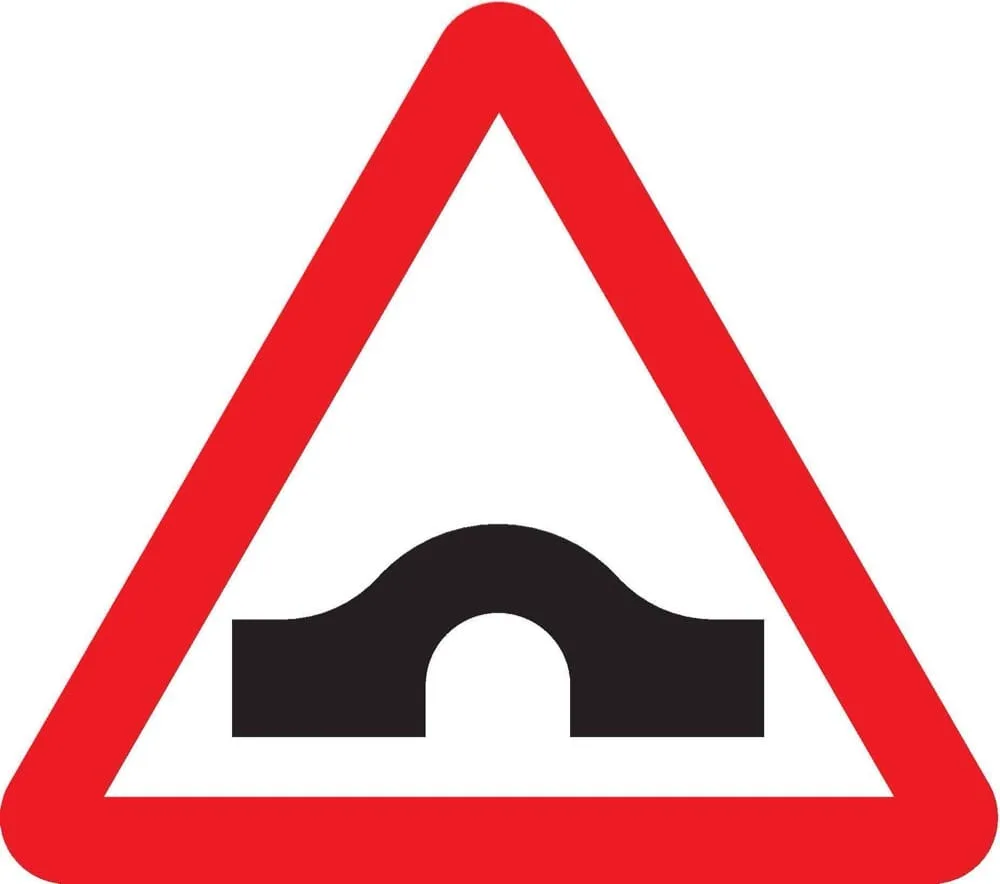
The ground clearance
The weight limit
The height limit
The load's security
Show the answer
The ground clearanceThis was the right answer
You have a responsibility to be aware of the dimensions of your vehicle, including ground clearance. When planning your route, you'll have to consider whether the roads you intend to use have any limits that would apply to your vehicle, such as
• weight
• length
• height
• ground clearance.
You are driving a large or slow vehicle towards a level crossing signed with an instruction for such vehicles to phone before crossing. What should you do?
Cross over using your horn and hazard warning lights
Stop before the crossing and phone the signal operator
Increase your speed to clear the crossing quickly
Stop before the crossing and look both ways before going on
Show the answer
Stop before the crossing and phone the signal operatorThis was the right answer
Stop safely, use the crossing telephone and obtain permission before crossing. Tell the operator if anything changes, and call back after crossing if asked. Follow the displayed instruction rather than assuming a universal vehicle-length threshold.
What type of fastening or restraint should you use when carrying a load of steel?
Chains
Straps
Ropes
Sheeting
Show the answer
ChainsThis was the right answer
You're responsible for the safety of the load you're carrying. At no time should the load endanger other road users. It's vital that you make sure your load is secure and safely distributed on your vehicle. How you do this will depend on the
• bulk
• weight
• type of vehicle you're driving (flat bed, curtain side, etc)
• nature of the load.
Under the STGO exceptional-width authorisation, a lorry carries a load 4.5 metres wide. What is its maximum motorway speed when no lower limit applies?
10 mph
20 mph
30 mph
40 mph
Show the answer
40 mphThis was the right answer
Article 30 sets 40 mph on motorways for this exceptional-width class. It covers the authorised class wider than 4.3 metres and no wider than 6.1 metres. Any lower applicable limit still applies.
Under the STGO exceptional-width authorisation, a lorry carries a load 4.5 metres wide. What is its maximum dual-carriageway speed when no lower limit applies?
15 mph
25 mph
35 mph
45 mph
Show the answer
35 mphThis was the right answer
For the authorised exceptional-width class, Article 30 sets 35 mph on dual carriageways, 40 on motorways and 30 on other roads, subject to lower applicable limits. Its width range is over 4.3 metres to 6.1 metres, not the archive’s upper value of 5 metres.
What colour are the markings on the rear of lorries over 7.5 tonnes maximum authorised mass?
Red/white
Red/yellow
Black/yellow
Black/white
Show the answer
Red/yellowThis was the right answer
All vehicles over 7.5 tonnes maximum authorised mass must have markings on the rear of the vehicle. These markings are rectangular and are coloured red and yellow. They're there to inform other road users of the characteristics of your vehicle. The markings should be kept clean so that they can be seen clearly at all times, especially at night and in poor visibility.
When this vehicle transporter turns, how will the overhanging top deck move?
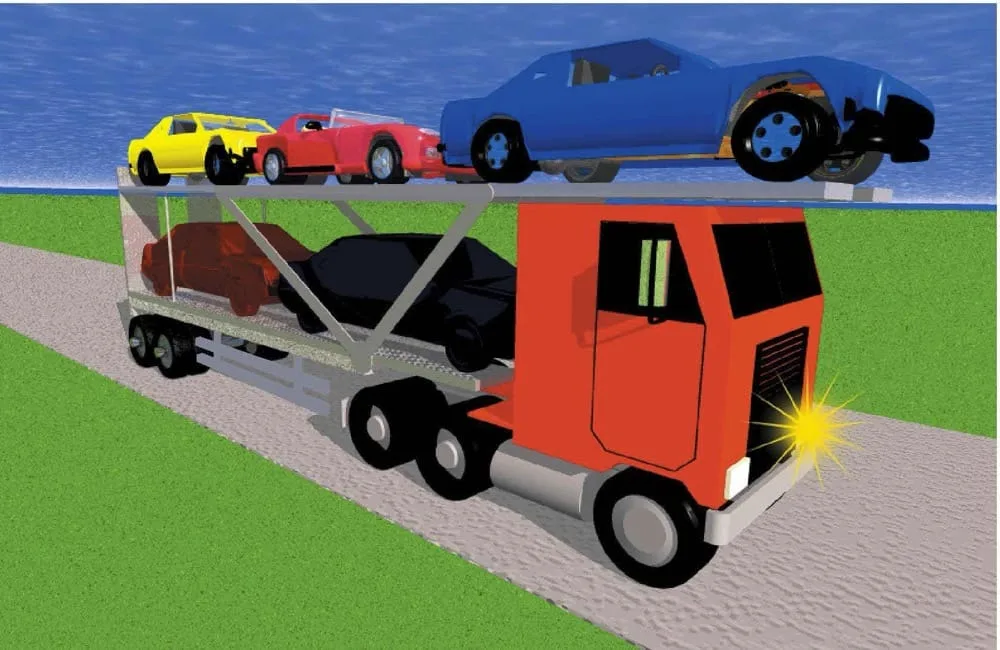
Through a greater arc than the cab
Through a lower arc than the cab
Through a smaller arc than the cab
Through the same arc as the cab
Show the answer
Through a greater arc than the cabThis was the right answer
As the top deck is longer than the cab and trailer, it will take up more room as the vehicle turns; you must make sure that you've allowed for the wider swing of the deck. Even if your cab is well clear, the overhanging deck could hit obstructions such as telegraph poles or traffic signs as you go round a corner.
You're the driver of an articulated car transporter. How will the overhanging top deck move as you turn corners?
Through a smaller arc than the cab
Through a shorter arc than the cab
Through a lower arc than the cab
Through a greater arc than the cab
Show the answer
Through a greater arc than the cabThis was the right answer
The longer top deck needs a wider turning circle than the cab below it. To avoid hitting lampposts, telegraph poles, etc, you must allow for this overhang when turning.
When would the driver of a car transporter need to be most aware of the front overhang of the trailer?
When overtaking
When turning
When loading
When braking
Show the answer
When turningThis was the right answer
The long overhang at the front of a car transporter can cause problems where street furniture, such as lampposts and traffic signs, is sited close to junctions. Particular problems may be encountered when you're turning right and there are 'Keep left' bollards in the middle of the road you're turning into. Plan your route carefully to avoid such hazards.
You're scheduled to make a delivery. You arrive at your destination during the morning rush hour. The road is edged with double red lines. What do they mean?
Unload only within a 'white box' area
Unload only within a 'red box' area
Delay your delivery until after the rush hour
Limit your stop to a maximum of 30 minutes
Show the answer
Unload only within a 'white box' areaThis was the right answer
White boxes allow you to unload at any time, but during the day the length of stay is restricted. You should check nearby signs for the specific times. At other times, when it's not so busy, there may not be any restrictions on parking.
You're driving a lorry with a maximum authorised mass of more than 7.5 tonnes. What's the national speed limit for your vehicle on a dual carriageway in England and Wales?
40 mph
50 mph
60 mph
70 mph
Show the answer
60 mphThis was the right answer
The speed limit for lorries is lower in Scotland than it is in England and Wales, so be aware - especially if you drive in the border areas.
Which driving action helps reduce a liquid tanker’s rollover risk at a bend?
Rely on the number of trailer axles
Brake sharply after steering into the bend
Reduce speed smoothly before the bend
Assume a posted speed is safe for every tanker
Show the answer
Reduce speed smoothly before the bendThis was the right answer
A tanker’s high centre of gravity and moving liquid increase rollover risk. Plan a suitably low entry speed and use smooth controls. No axle or tyre arrangement removes the need for careful driving.
Why should a tanker driver reduce speed before a bend instead of relying on the general posted speed?
Air suspension prevents all load movement
A tanker can roll over even at a posted bend speed
The differential lock automatically steers through it
Its air-pressure gauge shows the safe cornering speed
Show the answer
A tanker can roll over even at a posted bend speedThis was the right answer
A posted bend speed can be too fast for a tanker’s high centre of gravity and liquid movement. Slow before turning and avoid sudden steering or braking. Do not wait for wheel lift or an instrument warning.
What effect could a load of hanging meat carcasses cause when you drive around corners or bends?
The wave effect
The camber effect
The gravity effect
The pendulum effect
Show the answer
The pendulum effectThis was the right answer
Suspended carcasses can swing as the vehicle changes direction, creating a pendulum effect. Reduce speed before bends and use the specified restraints to limit movement.
Why do many drivers park at overnight stops with their rear doors close to another lorry?
To keep the load safe
To ensure a clear path
To keep 'same company' lorries together
To stop the theft of their fuel
Show the answer
To keep the load safeThis was the right answer
Load security is extremely important. Make sure you park legally and, preferably, in a well-lit area. Some lorry parks are patrolled regularly by the police or security services.
More lorry and bus topics
14 moreEvery question in this bank sits in one of these, and each one is a page like this.
Braking systems65 questionsCarrying passengers69 questionsDrivers' hours and rest periods78 questionsEnvironmental issues70 questionsEssential documents31 questionsIncidents, accidents and emergencies61 questionsLeaving the vehicle26 questionsOther road users83 questionsRestricted view38 questionsRoad and traffic signs85 questionsThe driver102 questionsThe road140 questionsVehicle condition102 questionsVehicle loading70 questionsAll lorry and bus questionsThe whole bank, in 15 topics