Loading the question bank
Lorry and bus · DVSA-based revision questions
Vehicle condition
102 LGV and PCV theory test questions on vehicle condition. Preview the questions below, or open one to read its answer and continue through the whole topic.
Practise
Be marked as you go
A session draws from all 102 of these, weakest first, and marks each answer the moment you give it. Nothing here needs an account.
The questions
20 of 102The first 20 in the order the pack holds them. Open the answer when you want to check yourself; a session draws from all 102 and marks you instead.
What's the main reason for cleaning your wheels and tyres when you leave a building site?
To keep the tyres in good condition
To prevent the tyres from damaging the road surface
To reduce air leakage from the tyre valves
To stop mud dropping onto the road
Show the answer
To stop mud dropping onto the roadThis was the right answer
If your wheels leave mud on the road, you must arrange for it to be cleared. A slippery, muddy surface could cause danger to other road users.
Your vehicle has double rear wheels. Why should you check them before leaving a building site?
To make sure the diff-lock is engaged
To make sure the diff-lock is disengaged
To check that the load-sensing valve is operating correctly
To make sure bricks or debris aren't wedged between the wheels
Show the answer
To make sure bricks or debris aren't wedged between the wheelsThis was the right answer
While driving on a building site, bricks, mud or other debris can become lodged between a lorry's double rear wheels. When you leave the site and increase your road speed, anything lodged between the tyres could be thrown out. This flying debris can be a hazard for drivers of following vehicles and can create dangerous road conditions, especially for motorcyclists.
What should you check before you drive off a muddy building site onto the road?
The diff-lock is disengaged
The diff-lock is engaged
The steering lock is engaged
The twist lock is disengaged
Show the answer
The diff-lock is disengagedThis was the right answer
Attempting to drive at normal speeds with the diff-lock engaged is dangerous; it will severely affect your steering control. The diff-lock is designed to be used in slippery conditions, at low speed, when maximum traction is required.
You're driving a lorry along a motorway. You notice that you're losing tread from one of your tyres. What should you do?
Stop safely in a place of relative safety and call for assistance
Stop on the hard shoulder and change the wheel
Continue driving to the next service station
Continue driving and leave by the next exit
Show the answer
Stop safely in a place of relative safety and call for assistanceThis was the right answer
Tyre tread separating is a dangerous defect. Keep control, slow smoothly and stop safely. On a motorway use a place of relative safety where possible; there may be no hard shoulder. Do not try an exposed roadside wheel change. If stranded in a live lane and unable to get out safely, keep seat belts and hazards on and call 999.
What is the minimum tread depth across the required three-quarters band on a lorry tyre when the vehicle exceeds 3.5 tonnes?
1 mm
1.5 mm
2.5 mm
5 mm
Show the answer
1 mmThis was the right answer
The large-vehicle requirement is at least 1 mm across three-quarters of the tread breadth, in a continuous band around the whole circumference. Goods vehicles of 3.5 tonnes or less generally use the separate 1.6 mm standard. Correct pressure and freedom from defects also matter.
During the final coupling stages, the lines are connected and trailer legs fully raised. What should you do before completing the full walkaround check?
Connect the brake lines
Release the trailer parking brake
Connect the electrical lines
Raise the trailer legs
Show the answer
Release the trailer parking brakeThis was the right answer
Follow the actual coupling procedure. HSE’s sequence includes releasing the trailer parking brake after connecting the lines and raising the legs, then checking the complete outfit, lights and brakes. This is not a substitute for the earlier visual locking check and controlled tug test.
When should your lorry coupling system (fifth wheel) be checked and lubricated?
Only prior to an MOT test
Every 6 months
Yearly
Regularly
Show the answer
RegularlyThis was the right answer
Check, inspect and lubricate the actual coupling under its manufacturer’s schedule. Conventional, lined and automatic-lubrication fifth wheels differ. Do not apply one monthly or 10,000 km interval, or one greasing method, to every design.
You're driving a new articulated lorry that's fully laden. You notice that the steering feels heavy. What's the most likely reason?
The road is icy
The power steering is faulty
The lorry is new
The load on the trailer has shifted
Show the answer
The power steering is faultyThis was the right answer
Heavy steering could mean there's a fault with the power steering. It should be investigated as soon as possible. Many large vehicles can become undriveable if the power steering fails completely.
When should wheel nuts be checked?
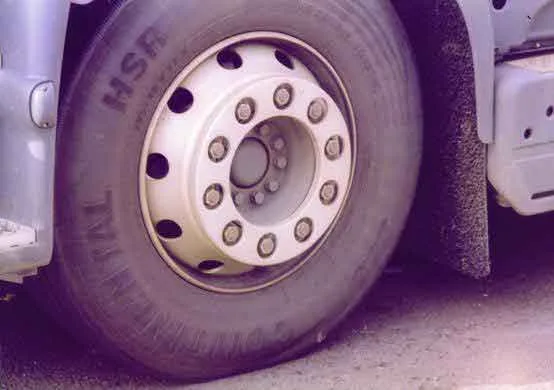
After driving down a steep hill
Soon after initial tightening
Just after driving on a motorway
After unloading
Show the answer
Soon after initial tighteningThis was the right answer
Always have wheel nuts checked soon after their initial tightening. They should be tightened to the torque specified by the vehicle manufacturer.
What would you secure with a dog clip?
The kingpin release handle
The air lines
The parking brake
The diff-lock
Show the answer
The kingpin release handleThis was the right answer
When recoupling, you must connect the dog clip to secure the kingpin release handle.
How frequently should the components of a fifth-wheel coupling be inspected?
Daily
Weekly
At the inspection intervals specified for the particular coupling
Yearly
Show the answer
At the inspection intervals specified for the particular couplingThis was the right answer
Use the coupling manufacturer’s inspection and maintenance schedule and inspect for damage before use. Low-maintenance and automatically lubricated designs differ from conventional fifth wheels. A calendar month alone is not a universal maintenance standard.
What should you check for wear or damage on a drawbar unit?
Dog clip
Fifth wheel
Kingpin release handle
Eyelet coupling
Show the answer
Eyelet couplingThis was the right answer
Check the drawbar eye and pin connection for security, wear and damage. Use the actual manufacturer’s limits and maintenance instructions. A fifth-wheel kingpin is a different coupling; do not assume all drawbar eyes use one heavy-grease procedure.
What's the fifth-wheel coupling used for?
To connect the tractor unit to the trailer
To support the trailer when it's detached
To prevent the trailer from jack-knifing
To attach air lines to the trailer
Show the answer
To connect the tractor unit to the trailerThis was the right answer
The fifth-wheel coupling is a device to connect the tractor unit to the trailer. It allows articulation between the tractor and trailer, and it should be regularly maintained.
How often should the components of the fifth-wheel coupling be inspected?
Every 3000 miles (5000 km)
At the distance or time intervals specified for that coupling
Every 9000 miles (15 000 km)
Every 12 000 miles (20 000 km)
Show the answer
At the distance or time intervals specified for that couplingThis was the right answer
Follow the actual coupling’s specified inspection intervals, including any time or operating-condition limit. JOST documents different conventional, lined and automatic-lubrication arrangements; 10,000 km is not a universal fifth-wheel interval.
You're uncoupling a trailer. What must you do before disconnecting any of the air lines?
Drain the air tanks
Apply the trailer parking brake
Lower the landing gear
Disconnect the electrical line
Show the answer
Apply the trailer parking brakeThis was the right answer
Whenever you uncouple a trailer, you must work through the uncoupling process methodically. Start by making sure that the brakes are applied on both the vehicle and the trailer.
You're checking your vehicle's tyres before starting a long motorway journey. What check should be made on each tyre?
Air pressure
Tracking
Valve clearance
Tyre profile
Show the answer
Air pressureThis was the right answer
Check each tyre’s pressure for the load, preferably when cold, together with its condition and tread. Correct maintenance reduces failure risk but does not guarantee a tyre cannot fail during a motorway journey.
What should you do if you notice that two wheel nuts are missing from one of the wheels on your vehicle?
Continue your journey
Drive to the nearest tyre depot
Use a nut from another wheel
Park and phone for assistance
Show the answer
Park and phone for assistanceThis was the right answer
If you notice any missing wheel nuts, park and phone for assistance. It's essential that all wheel fixings are in place and tightened to the torque specified by the manufacturer. Checks should be made before you start any journey, but make a visual check every time you start up again after a rest stop.
On a large goods vehicle over 3.5 tonnes, which of these tyre conditions is illegal?
Using different makes of tyre on the same axle
Using a tyre with a recut tread
Using a tyre with a tread depth of 1.3 mm
Using a tyre with exposed ply or cord
Show the answer
Using a tyre with exposed ply or cordThis was the right answer
Exposed ply or cord is a dangerous tyre defect. The minimum heavy-vehicle tread standard differs from the 1.6 mm car and light-van requirement, so the question is explicitly about a vehicle over 3.5 tonnes. Recut tyres must be suitable and lawfully regrooved, not improvised.
Your air-brake system has manually drained reservoirs and no air dryer. What routine helps prevent collected moisture freezing?
Cover the air tanks with a blanket
Drain the tanks daily
Use the brakes frequently
Pump the brakes
Show the answer
Drain the tanks dailyThis was the right answer
For this manual-drain system, drain the reservoirs daily using the safe instructed procedure. Systems with an air dryer or automatic drains have different inspection and maintenance schedules. Moisture can freeze and interfere with braking; never assume an unfamiliar system drains itself.
The parking brake is released but this warning remains on. Which system needs investigation?

Low oil pressure
Battery discharge
Braking-system fault
Door open
Show the answer
Braking-system faultThis was the right answer
The circle-and-exclamation symbol is the brake-system warning. It can have a normal parking-brake indication, but a persistent warning after release needs investigation. Stop safely if it appears during travel and do not continue with an unresolved brake fault.
More lorry and bus topics
14 moreEvery question in this bank sits in one of these, and each one is a page like this.
Braking systems65 questionsCarrying passengers69 questionsDrivers' hours and rest periods78 questionsEnvironmental issues70 questionsEssential documents31 questionsIncidents, accidents and emergencies61 questionsLeaving the vehicle26 questionsOther road users83 questionsRestricted view38 questionsRoad and traffic signs85 questionsThe driver102 questionsThe road140 questionsVehicle loading70 questionsVehicle weights and dimensions76 questionsAll lorry and bus questionsThe whole bank, in 15 topics