Loading the question bank
Lorry and bus · DVSA-based revision questions
The driver
102 LGV and PCV theory test questions on the driver. Preview the questions below, or open one to read its answer and continue through the whole topic.
Practise
Be marked as you go
A session draws from all 102 of these, weakest first, and marks each answer the moment you give it. Nothing here needs an account.
The questions
20 of 102The first 20 in the order the pack holds them. Open the answer when you want to check yourself; a session draws from all 102 and marks you instead.
You're approaching a green traffic light and are going straight ahead. What should you do when the traffic ahead, beyond the junction, has stopped and is queuing?
Go forward if your vehicle will clear the junction
Drive slowly across the junction
Maintain your speed and sound your horn
Stop across the junction until the traffic clears
Show the answer
Go forward if your vehicle will clear the junctionThis was the right answer
Look well ahead and plan your approach to all junctions. Even if the traffic lights are green, don't go forward if queuing traffic will cause you to block the junction. Be aware of the length of your vehicle and how much space it needs to clear the junction.
What rules apply to the wearing of seat belts fitted to your lorry?
It's not advisable
It's advisable
It's required by law
It's not required by law
Show the answer
It's required by lawThis was the right answer
If seat belts are fitted to your lorry, you must wear them. Exemptions are allowed for holders of medical exemption certificates and for delivery drivers when travelling less than 50 metres (162 feet).
You're driving this lorry and are waiting to turn right. What should you do just before turning?
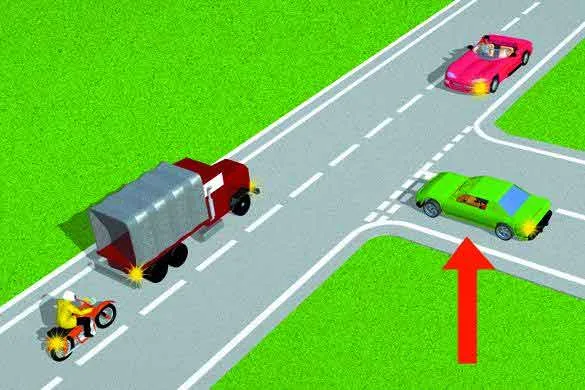
Cancel your signal
Check your left-hand mirror and blind spot
Wave out the green car (arrowed)
Check your right-hand mirror and blind spot
Show the answer
Check your right-hand mirror and blind spotThis was the right answer
Always make a final check in your mirrors and check your blind spots before you turn. Another driver or a motorcyclist may have committed themselves to overtaking traffic behind you before realising you intend to turn.
What will you have to deal with when you're driving at night?
Headlight dazzle
Other drivers speeding
Cold weather conditions
Dazzle from shop windows
Show the answer
Headlight dazzleThis was the right answer
At night, the headlights of oncoming traffic can dazzle you, reducing how much you can see of the road ahead. Reduce your speed so that you can safely respond to any situation that may arise and make sure you've dipped your headlights.
You're driving a lorry in a busy town. A driver pulls out in front of you and you have to brake hard. What should you do?
Overtake as quickly as possible
Stay calm and accept the error
Flash your lights to show your annoyance
Sound your horn and speed up
Show the answer
Stay calm and accept the errorThis was the right answer
Some drivers might emerge from a junction when it's not safe to do so. In this situation, understand that other drivers might make mistakes. Don't intimidate them by driving aggressively to teach them a lesson.
Your lorry is fitted with a driver's seat belt. When may you drive without wearing it?
When you're making deliveries that are less than 50 metres apart
When you're towing at less than 50 mph
When you're working less than 50 hours in a week
When you're less than 50 miles away from your depot
Show the answer
When you're making deliveries that are less than 50 metres apartThis was the right answer
It's compulsory for drivers and passengers to wear seat belts. However, if you're making deliveries that are less than 50 metres apart, you may leave the seat belt undone. It would be impractical to keep fastening and unfastening your seat belt over such short distances.
You've been issued with protective clothing. Who's responsible for its use?
You, the driver
The insurance company
The Health and Safety Executive
Your employer
Show the answer
You, the driverThis was the right answer
Protective clothing will usually be provided by your company. However, it's your responsibility to make sure that you use it properly.
You're driving on a motorway. What does it mean when a lorry ahead of you switches on its hazard warning lights?
There are speed cameras ahead
The lorry is about to overtake
The lorry is leaving the motorway
Traffic further ahead may be stopping
Show the answer
Traffic further ahead may be stoppingThis was the right answer
When someone ahead of you switches on their hazard warning lights, it means that they've spotted a hazard that you may not be able to see yet. Slow down and be ready to stop if necessary.
What should you do if you lose your way in heavy traffic?
Stop at traffic lights and ask pedestrians
Shout to other drivers to ask them the way
Drive on until you find a safe place to stop
Check a map as you keep moving with the traffic
Show the answer
Drive on until you find a safe place to stopThis was the right answer
Driving in heavy traffic needs 100% concentration. If you become lost, find a safe place to stop before checking a map or asking for directions. Don't risk losing concentration by glancing at a map while driving, even if you're in traffic that keeps stopping.
Where are you most likely to find pedestrians stepping into the road?
Motorways
One-way streets
Wooded areas
Shopping areas
Show the answer
Shopping areasThis was the right answer
In shopping areas, pedestrians frequently want to cross the road. They may be hidden by parked vehicles before stepping out into your path. Keep your speed down and be aware of the risk of pedestrians suddenly walking into the road.
What's most likely to cause danger to a group of horse riders?
Powerful brake lights
Leaving plenty of room
The noise of your vehicle
Reacting too early
Show the answer
The noise of your vehicleThis was the right answer
The hiss of air-assisted mechanisms, as well as engine noise, can easily startle horses. Keep the noise to a minimum by gentle use of the brakes and, if necessary, stopping and turning your engine off.
What should you do when passing sheep on a road?
Pass quickly and quietly
Sound your horn gently
Drive very slowly
Keep your vehicle moving
Show the answer
Drive very slowlyThis was the right answer
Animals can be very unpredictable. You should give them as much room as you can, keep your speed and noise to a minimum to avoid panicking them, and always be ready to stop if necessary.
When is your nearside mirror most likely to endanger pedestrians?
When driving over a speed hump
When driving near a hospital
When driving close to the kerb
When driving past a car park
Show the answer
When driving close to the kerbThis was the right answer
When you drive too close to the kerb, there's a risk that your nearside mirror could strike the head of a pedestrian. Be aware of this hazard and, if you see pedestrians close to the road, make sure you leave them enough room.
What can prevent you from holding a bus or lorry driving licence?
Heart disorders
Dyslexia
Skin problems
Stomach problems
Show the answer
Heart disordersThis was the right answer
A heart disorder can make bus or lorry driving unsafe because of sudden incapacity. Group 2 conditions have specific rules: for example, angina must be reported to DVLA and driving must stop when symptoms occur. Seek medical advice promptly and follow the applicable reporting and driving restriction. There is no general permission to wait three months before reporting a notifiable condition.
You're about to drive a vehicle you've never driven before. What should you consider when adjusting your seat?
Your distance from the controls
Being able to reach your sat-nav
The tension in the seat belt
The wear on the seat fabric
Show the answer
Your distance from the controlsThis was the right answer
Being seated properly is very important when driving long distances. A poor driving position can quickly cause fatigue. You should make sure that you can reach all the controls comfortably.
Why is it important to adjust your head restraint properly?
To make you more comfortable
To protect your neck in a collision
To help you relax while you're driving
To maintain a good driving position
Show the answer
To protect your neck in a collisionThis was the right answer
Your head restraint should be adjusted so that, in the event of a collision, it protects your neck from whiplash injury.
When may you drive without wearing your seat belt?
When reversing
When carrying out a hill start
When making an emergency stop
When driving slowly
Show the answer
When reversingThis was the right answer
You can legally remove your seat belt when carrying out a manoeuvre that involves reversing. Don't forget to put it back on again when you've finished.
You're driving along this road. What should you do if the red car cuts in close in front of you?
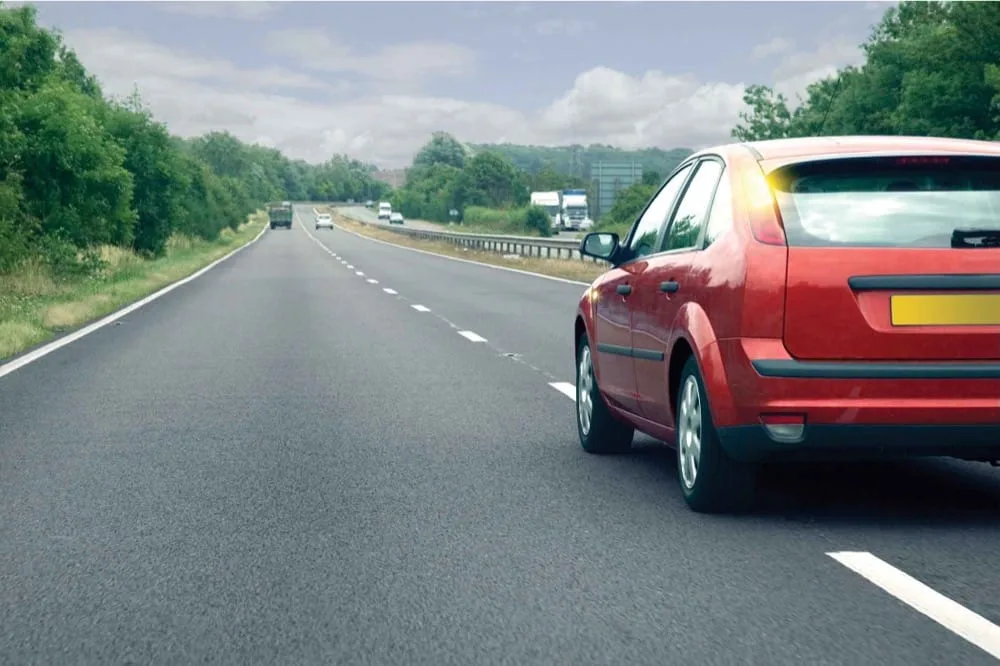
Accelerate to get closer to the red car
Give a long blast on the horn
Drop back to leave the correct separation distance
Flash your headlights several times
Show the answer
Drop back to leave the correct separation distanceThis was the right answer
There are times when other road users make incorrect or ill-judged decisions. Try to stay calm and don't retaliate or react aggressively, especially as your vehicle is likely to be larger and more intimidating than the other person's. Always put safety first.
You're approaching a large puddle near the left-hand kerb. What should you do if pedestrians are close to the water?
Ignore the puddle
Brake suddenly and sound your horn
Try to avoid splashing the pedestrians
Wave at the pedestrians to keep back
Show the answer
Try to avoid splashing the pedestriansThis was the right answer
The effect of your vehicle driving through a puddle will be to throw water onto the pavement. If there are pedestrians close by, they could be splashed with the water. Be considerate and, if it's safe to do so, avoid driving through the puddle.
What should you do if a long, heavily laden lorry is taking a long time to overtake you?
Speed up
Slow down
Hold your speed
Change direction
Show the answer
Slow downThis was the right answer
A long lorry with a heavy load will need more time to pass you than a car. It won't be able to accelerate enough to pass you quickly, especially on an uphill stretch of road. Be considerate to the lorry driver - ease off the accelerator and allow the lorry to pass.
More lorry and bus topics
14 moreEvery question in this bank sits in one of these, and each one is a page like this.
Braking systems65 questionsCarrying passengers69 questionsDrivers' hours and rest periods78 questionsEnvironmental issues70 questionsEssential documents31 questionsIncidents, accidents and emergencies61 questionsLeaving the vehicle26 questionsOther road users83 questionsRestricted view38 questionsRoad and traffic signs85 questionsThe road140 questionsVehicle condition102 questionsVehicle loading70 questionsVehicle weights and dimensions76 questionsAll lorry and bus questionsThe whole bank, in 15 topics