Loading the question bank
Lorry and bus · DVSA-based revision questions
Restricted view
38 LGV and PCV theory test questions on restricted view. Preview the questions below, or open one to read its answer and continue through the whole topic.
Practise
Be marked as you go
A session draws from all 38 of these, weakest first, and marks each answer the moment you give it. Nothing here needs an account.
The questions
20 of 38The first 20 in the order the pack holds them. Open the answer when you want to check yourself; a session draws from all 38 and marks you instead.
Some lorries have an extra mirror angled down towards the nearside front wheel. What's this mirror especially useful for?
Overtaking
Parking
Checking your trailer
Turning right
Show the answer
ParkingThis was the right answer
Sitting in a high cab doesn't always give you all-round visibility. Other road users might assume that you can see them and position themselves out of sight close to your vehicle. Making good use of any extra mirrors can help prevent dangerous incidents, especially when parking.
What should you look for when choosing a site to park your trailer?
The site should be level
The site should be made of concrete
The site should be sheltered
The site should have marked parking bays
Show the answer
The site should be levelThis was the right answer
Check that the ground is firm and level before you uncouple the trailer. If you need to, place a heavy plank under the legs to distribute the weight and stop the legs sinking into the ground. Don't park illegally. Make sure that your unattended trailer isn't blocking access for others.
You're behind a parked car. What should you do when you're about to move off?
Start to signal when you've started moving
Move off when there's no oncoming traffic
Check the blind spots before you start moving
Only use your mirrors after you've started moving
Show the answer
Check the blind spots before you start movingThis was the right answer
Because the body of your vehicle is designed to take loads, your view around it will be restricted. Take extra care to look well out of the window to check the blind spots. Don't forget to check all the mirrors. Check ahead and signal, if necessary, before moving off.
You’re driving a lorry. Why do you need to take extra care when turning left at this junction?
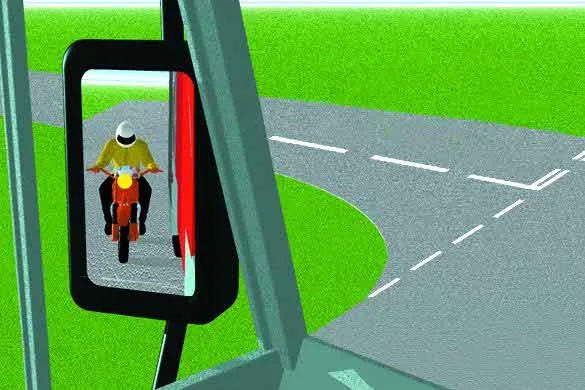
There are no bollards in the middle of the road
It's a closed junction
There's a motorcycle on the left
There's a grass verge on the left
Show the answer
There's a motorcycle on the leftThis was the right answer
Make sure that you signal in good time, so that the motorcyclist behind you knows your intention. You may have to position yourself wide in order to negotiate the junction. Be aware that the motorcyclist may see this as an opportunity to filter through on your nearside. Check your left-hand mirror carefully before you start to turn.
You're driving this lorry (arrowed). What should you do about the emergency vehicle that's trying to emerge from the side road?
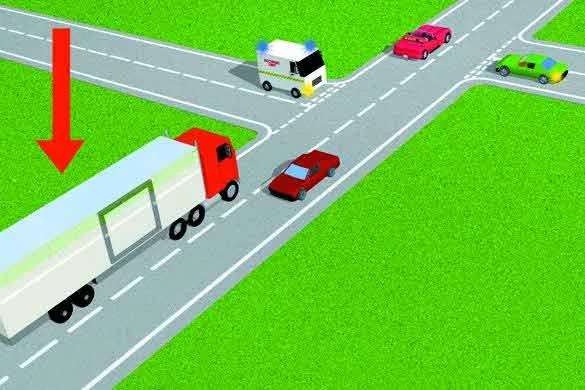
Brake hard to a stop and wave it out
Brake smoothly and allow it to emerge
Drive on; you're on the major road
Turn left to give it a clear view
Show the answer
Brake smoothly and allow it to emergeThis was the right answer
Good forward planning will allow you to deal safely with this situation. You need to assess how your actions will affect other road users. Acting on impulse can have disastrous consequences.
What should you do when you're unable to see clearly while you're reversing into a loading bay?
Stop and get a trained signaller to guide you under the safe site procedure
Use an audible warning signal while reversing
Reverse into the bay until your bumper touches the end wall
Open your door and lean well out while reversing
Show the answer
Stop and get a trained signaller to guide you under the safe site procedureThis was the right answer
Stop when the view is inadequate. Under an assessed reversing procedure, a trained signaller can guide you from a safe, visible position using agreed signals. Stop immediately if you lose sight of them. An alarm or an untrained bystander does not make a blind manoeuvre safe.
This lorry is turning right from the side road. What should the driver be especially aware of?
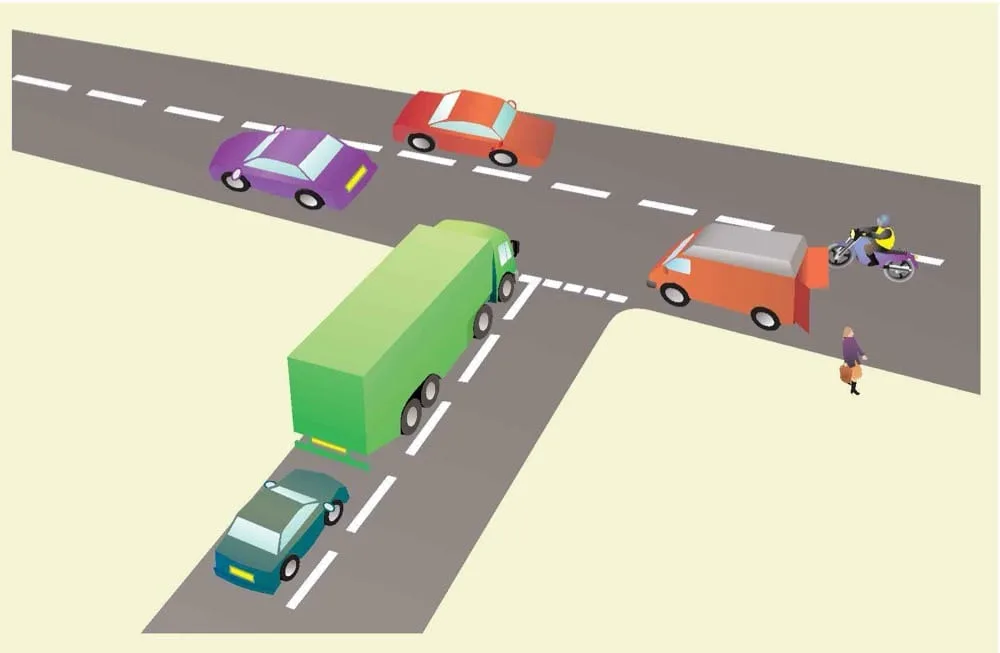
The motorcyclist from the right passing the parked van
The vehicles coming from the left along the main road
The pedestrians on the footpath by the main road
The vehicles behind on the minor road
Show the answer
The motorcyclist from the right passing the parked vanThis was the right answer
Parked vehicles near junctions can hide smaller road users such as cyclists and motorcyclists. Double-check before emerging with a large vehicle. If in doubt, move forward slowly into a position where you can safely have another look.
You're parking your lorry at night. Where must you use parking lights?
On the road
In a motorway service area
In a factory entrance
In dock-authority areas
Show the answer
On the roadThis was the right answer
Goods vehicles exceeding 2500 kg laden weight must always have their parking lights switched on when they're parked on the road at night. This includes parking in lay-bys: other drivers entering the lay-by must be able to see the vehicle.
You're driving a lorry with a sleeper cab. When would a quick sideways glance be helpful?
After driving over a pedestrian crossing
When traffic is merging from the right or left
Before climbing a steep hill
When driving round sharp bends
Show the answer
When traffic is merging from the right or leftThis was the right answer
The size and design of some cabs can create blind spots. This is especially true of a sleeper cab. A quick sideways glance might show something you can't see in your mirrors, especially when traffic is merging.
Your lorry has a sleeper cab. Why could this make your driving more difficult?
It increases your blind spots
It increases your view of the road ahead
It increases your view in the right-hand mirror
It increases your view in the left-hand mirror
Show the answer
It increases your blind spotsThis was the right answer
A sleeper cab can create extra blind spots. Look out for vehicles just to the rear offside and nearside of your cab - they could soon become hidden in your blind spots.
You are turning right in the arrowed lorry. Who should you give way to so they can cross the entrance of the side road?
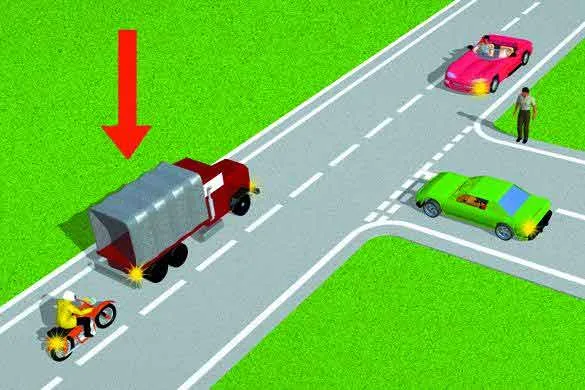
The motorcyclist
The driver in the red car
The driver in the green car
The pedestrian
Show the answer
The pedestrianThis was the right answer
Give way to a pedestrian crossing or waiting to cross the road into which you are turning. You must also wait for a safe gap in oncoming traffic and check for anyone overtaking before turning. Pedestrian priority is not permission to turn across another vehicle’s path.
Many modern vehicles are fitted with an additional nearside mirror. What does this help the driver to see?
The front wheel in relation to the kerb
The exhaust to check for emissions
The rear of the vehicle when reversing
The distance of the following vehicle
Show the answer
The front wheel in relation to the kerbThis was the right answer
This mirror is specifically positioned so that the driver can see the position of the front nearside wheel in relation to the kerb. Use it when pulling in to park alongside the kerb or when you have to move close to the left in normal driving.
Your lorry has a mirror to show the area immediately in front of the vehicle. When should you use this mirror?
Before moving off
Before you change lane on a motorway
While you're reversing
Before getting out of the cab
Show the answer
Before moving offThis was the right answer
From your raised driving position, you may not be able to see the area directly in front you. The Class VI (Cyclops) mirror on the front of your vehicle can reveal pedestrians, cyclists and motorcyclists who would otherwise be hidden from view. Check this mirror carefully before moving off, especially at pedestrian crossings and in stop/start city traffic.
You’re driving your lorry through a busy area and you’ve stopped at a pedestrian crossing. What should you do before you move off?
Check the Class VI mirror on the front of your lorry
Wave any remaining pedestrians across the road
Ease forward onto the crossing to check that it’s clear
Rev your engine
Show the answer
Check the Class VI mirror on the front of your lorryThis was the right answer
Be aware that cyclists and pedestrians could be hidden from view when you’re in slow-moving traffic or at pedestrian crossings. The Class VI (Cyclops) mirror on the front of your vehicle shows the area directly in front of you. Use this mirror to check that no-one is in front of your vehicle before you start to move.
What's the first thing you should check before moving to the left?
The nearside mirror
The offside mirror
Behind, over your right shoulder
Behind, over your left shoulder
Show the answer
The nearside mirrorThis was the right answer
Before you make a turn or a change of direction, however slight, you should always check the mirrors. If you intend to turn left, check your left-hand (nearside) mirror first.
What's the first thing you should check before moving to the right?
The nearside mirror
Behind, over your left shoulder
Behind, over your right shoulder
The offside mirror
Show the answer
The offside mirrorThis was the right answer
If you intend to turn right, check your right-hand (offside) mirror first. All of your mirrors should be properly adjusted to give a clear view around and behind your vehicle. They should be kept clean at all times and shouldn't be cracked or broken.
What should you do before moving off?
Extend your right arm out of the window
Just use the offside mirror and move away quickly
Signal right with indicator and arm together
Use your mirrors and look behind
Show the answer
Use your mirrors and look behindThis was the right answer
To make sure it's safe, you must use the mirrors well before you make any manoeuvre. For example, you need to use them before moving off, turning, overtaking, slowing or stopping, opening a door, or changing direction, lanes or speed.
When would you need to check your nearside mirror?
As a final check before turning right
After passing cars parked on the left
Before moving into the lane on your right
When getting out of your cab on the driver's side
Show the answer
After passing cars parked on the leftThis was the right answer
As you pass pedestrians or vehicles on your left, you should use your nearside mirror and check that you've passed them safely. You need to allow a good safety margin before you move back to the left.
The MSM routine should be used when you negotiate a hazard. What do the initials MSM stand for?
Mirrors, signal, manoeuvre
Manoeuvre, speed, mirrors
Mirrors, speed, manoeuvre
Manoeuvre, signal, mirrors
Show the answer
Mirrors, signal, manoeuvreThis was the right answer
Always use the MSM routine when you're approaching a hazard.
M - Mirrors: check the position of the traffic behind you.
S - Signal: signal your intention to slow down or change course in good time.
M - Manoeuvre: a manoeuvre is any change in position, from slowing or stopping the vehicle to turning off a busy road.
What does this sign mean?
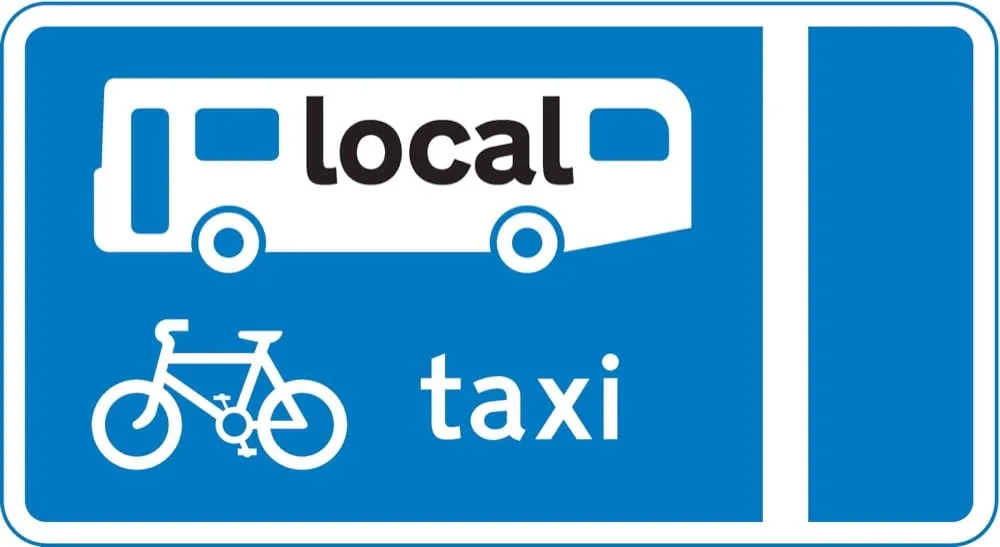
Contraflow bus and cycle lane
With-flow bus and cycle lane
No buses or cycles
Priority to buses or cycles
Show the answer
With-flow bus and cycle laneThis was the right answer
Some lanes are set aside for certain types of vehicle. Signs and road markings show the authorised vehicles in words or pictures. There's usually also a sign showing the times that the lane is in operation. Some lanes might only be in operation for a short time. Check the sign and only use the lane if you're allowed to do so.
More lorry and bus topics
14 moreEvery question in this bank sits in one of these, and each one is a page like this.
Braking systems65 questionsCarrying passengers69 questionsDrivers' hours and rest periods78 questionsEnvironmental issues70 questionsEssential documents31 questionsIncidents, accidents and emergencies61 questionsLeaving the vehicle26 questionsOther road users83 questionsRoad and traffic signs85 questionsThe driver102 questionsThe road140 questionsVehicle condition102 questionsVehicle loading70 questionsVehicle weights and dimensions76 questionsAll lorry and bus questionsThe whole bank, in 15 topics