Loading the question bank
Car · DVSA-based revision questions
Safety and your vehicle
77 car theory test questions on safety and your vehicle. Preview the questions below, or open one to read its answer and continue through the whole topic.
Practise
Be marked as you go
A session draws from all 77 of these, weakest first, and marks each answer the moment you give it. Nothing here needs an account.
The questions
20 of 77The first 20 in the order the pack holds them. Open the answer when you want to check yourself; a session draws from all 77 and marks you instead.
How would under-inflated tyres affect your vehicle?
The vehicle's stopping distance would increase
The flash rate of the vehicle's indicators would increase
The vehicle's gear change mechanism would become stiff
The vehicle's headlights would aim high
Show the answer
The vehicle's stopping distance would increaseThis was the right answer
Your tyres are your only contact with the road. To prevent problems with braking and steering, keep your tyres free from defects; they must have sufficient tread depth and be correctly inflated. Correct tyre pressures help reduce the risk of skidding and provide a safer and more comfortable drive or ride.
When are you not allowed to sound your vehicle's horn?
Between 10.00 pm and 6.00 am in a built-up area
At any time in a built-up area
Between 11.30 pm and 7.00 am in a built-up area
Between 11.30 pm and 6.00 am on any road
Show the answer
Between 11.30 pm and 7.00 am in a built-up areaThis was the right answer
Every effort must be made to prevent excessive noise, especially in built-up areas at night. Don’t rev your engine or sound the horn unnecessarily. It's illegal to sound your horn in a built-up area between 11.30 pm and 7.00 am, except when another road user poses a danger.
What makes the vehicle in the picture 'environmentally friendly'?
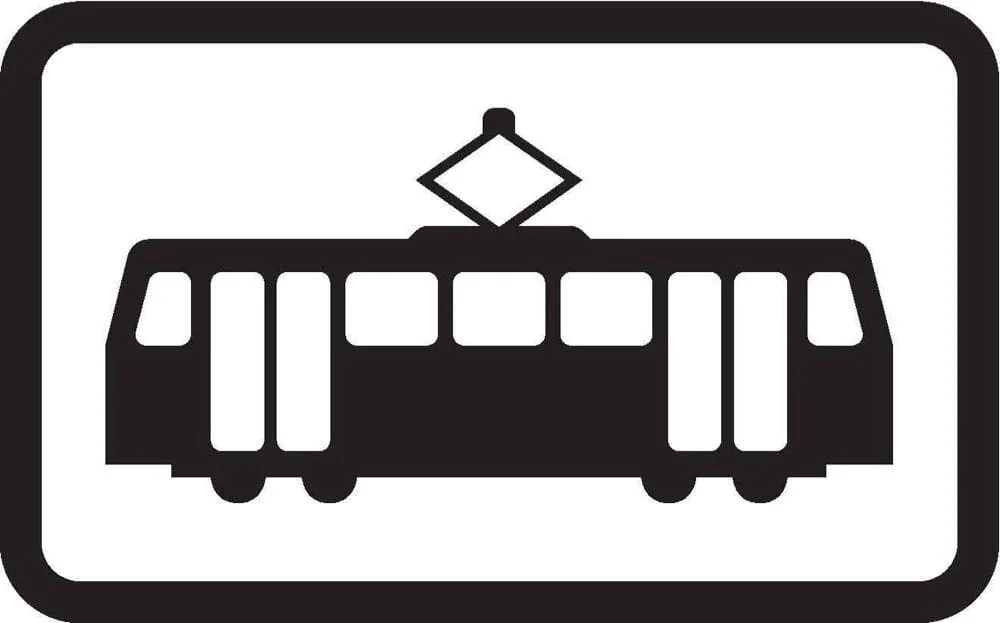
It's powered by gravity
It's powered by diesel
It's powered by electricity
It's powered by unleaded petrol
Show the answer
It's powered by electricityThis was the right answer
Trams are powered by electricity and therefore don't emit exhaust fumes. They ease traffic congestion by offering drivers an alternative to using their car, particularly in busy cities and towns.
Why have 'red routes' been introduced in major cities?
To raise the speed limits
To help the traffic flow
To provide better parking
To allow lorries to load more freely
Show the answer
To help the traffic flowThis was the right answer
Inconsiderate parking can obstruct the flow of traffic and so make traffic congestion worse. Red routes are designed to prevent this by enforcing strict parking restrictions. Driving slowly in traffic increases fuel consumption and causes a build-up of exhaust fumes.
What's the purpose of road humps, chicanes and narrowings?
To separate lanes of traffic
To increase traffic speed
To allow pedestrians to cross
To reduce traffic speed
Show the answer
To reduce traffic speedThis was the right answer
Traffic-calming measures help to keep vehicle speeds low in congested areas where there are pedestrians and children. A pedestrian is much more likely to survive a collision with a vehicle travelling at 20 mph than they are with a vehicle travelling at 40 mph.
What's the purpose of a catalytic converter?
To reduce fuel consumption
To reduce the risk of fire
To reduce harmful exhaust gases
To reduce engine wear
Show the answer
To reduce harmful exhaust gasesThis was the right answer
Catalytic converters reduce a large percentage of harmful exhaust emissions. They work more efficiently when the engine has reached its normal working temperature.
When should tyre pressures be checked?
After any lengthy journey
After travelling at high speed
When tyres are hot
When tyres are cold
Show the answer
When tyres are coldThis was the right answer
Check the tyre pressures when the tyres are cold. This will give you a more accurate reading. The heat generated on a long journey will raise the pressure inside the tyre.
When will your vehicle use more fuel?
When its tyres are under-inflated
When its tyres are of different makes
When its tyres are over-inflated
When its tyres are new
Show the answer
When its tyres are under-inflatedThis was the right answer
Check your tyre pressures frequently - normally once a week. If they're lower than those recommended by the manufacturer, there will be more 'rolling resistance'. The engine will have to work harder to overcome this, leading to increased fuel consumption.
How should you dispose of a used vehicle battery?
Bury it in your garden
Put it in the dustbin
Take it to a local-authority disposal site
Leave it on waste land
Show the answer
Take it to a local-authority disposal siteThis was the right answer
Batteries contain acid, which is hazardous, and they must be disposed of safely. This means taking them to an appropriate disposal site.
What's most likely to increase fuel consumption?
Poor steering control
Accelerating around bends
Staying in high gears
Harsh braking and accelerating
Show the answer
Harsh braking and acceleratingThis was the right answer
Accelerating and braking gently and smoothly will help to save fuel and reduce wear on your vehicle. This makes it better for the environment too.
The fluid level in your battery is low. What fluid should you use to top it up?
Battery acid
Distilled water
Engine oil
Engine coolant
Show the answer
Distilled waterThis was the right answer
Some modern batteries are maintenance free. Check your vehicle handbook and, if necessary, make sure that the plates in each battery cell are covered with fluid.
You're parked on the road at night. When must you use parking lights?
When there are continuous white lines in the middle of the road
When the speed limit exceeds 30 mph
When you're facing oncoming traffic
When you're near a bus stop
Show the answer
When the speed limit exceeds 30 mphThis was the right answer
When parking at night, park in the direction of the traffic. This will enable other road users to see the reflectors on the rear of your vehicle. Use your parking lights if the speed limit is over 30 mph.
How can you reduce the environmental harm caused by your motor vehicle?
Only use it for short journeys
Don't service it
Drive faster than normal
Keep engine revs low
Show the answer
Keep engine revs lowThis was the right answer
Engines that burn fossil fuels produce exhaust emissions that are harmful to health. The harder you make the engine work, the more emissions it will produce. Engines also use more fuel and produce higher levels of emissions when they're cold. Anything you can do to reduce your use of fossil fuels will help the environment.
What can cause excessive or uneven tyre wear?
A faulty gearbox
A faulty braking system
A faulty electrical system
A faulty exhaust system
Show the answer
A faulty braking systemThis was the right answer
If you see that parts of the tread on your tyres are wearing before others, it may indicate a brake, suspension or wheel-alignment fault. Regular servicing will help to detect faults at an early stage and this will avoid the risk of minor faults becoming serious or even dangerous.
You need to top up your battery with distilled water. What level should you fill it to?
The top of the battery
Halfway up the battery
Just below the cell plates
Just above the cell plates
Show the answer
Just above the cell platesThis was the right answer
Top up the battery with distilled water and make sure each cell plate is covered.
How can you plan your route before starting a long journey?
Check your vehicle handbook
Ask your local garage
Use a route planner on the internet
Consult a travel agent
Show the answer
Use a route planner on the internetThis was the right answer
Various route planners are available on the internet. Most of them give you several options, allowing you to choose between the most direct route and quieter roads. They may also identify rest and fuel stops. Print off the directions and take them with you.
Why is it a good idea to plan your journey to avoid busy times?
You'll have an easier journey
You'll have a more stressful journey
Your journey time will be longer
It will cause more traffic congestion
Show the answer
You'll have an easier journeyThis was the right answer
No-one likes to spend time in traffic queues. Try to avoid busy times related to school or work travel.
How will your journey be affected by travelling outside the busy times of day?
Your journey will use more fuel
Your journey will take longer
Your journey will be more hazardous
Your journey will have fewer delays
Show the answer
Your journey will have fewer delaysThis was the right answer
If possible, avoid the early morning, late afternoon and early evening ‘rush hour’. Doing this should allow you to have a better journey, with fewer delays. This should help you to arrive at your destination feeling less stressed.
You plan your route before starting a journey. Why should you also plan an alternative route?
Your original route may be blocked
Your maps may have different scales
You may find you have to pay a congestion charge
You may get held up by a tractor
Show the answer
Your original route may be blockedThis was the right answer
It can be frustrating and worrying to find your planned route is blocked by roadworks or diversions. If you've planned an alternative, you'll feel less stressed and more able to concentrate fully on your driving or riding. If your original route is mostly on motorways, it’s a good idea to plan an alternative using non-motorway roads. Always carry a map with you just in case you need to refer to it.
You have to arrive on time for an appointment. How should you plan for the journey?
Allow plenty of time for the trip
Plan to travel at busy times
Avoid roads with the national speed limit
Prevent other drivers from overtaking
Show the answer
Allow plenty of time for the tripThis was the right answer
Always allow plenty of time for your journey in case of unforeseen problems. Anything can happen; for example, punctures, breakdowns, road closures, diversions and delays. You'll feel less stressed and less inclined to take risks if you aren't ‘pushed for time’.
More car topics
13 moreEvery question in this bank sits in one of these, and each one is a page like this.
Alertness26 questionsAttitude39 questionsEssential documents28 questionsHazard awareness78 questionsIncidents, accidents and emergencies48 questionsMotorway rules57 questionsOther types of vehicle22 questionsRoad and traffic signs133 questionsRules of the road67 questionsSafety margins34 questionsVehicle handling45 questionsVehicle loading21 questionsVulnerable road users71 questionsAll car questionsThe whole bank, in 14 topics