Loading the question bank
Car · DVSA-based revision questions
Alertness
26 car theory test questions on alertness. Preview the questions below, or open one to read its answer and continue through the whole topic.
Practise
Be marked as you go
A session draws from all 26 of these, weakest first, and marks each answer the moment you give it. Nothing here needs an account.
The questions
20 of 26The first 20 in the order the pack holds them. Open the answer when you want to check yourself; a session draws from all 26 and marks you instead.
What should you do before making a U-turn?
Give an arm signal as well as using your indicators
Check road markings to see that U-turns are permitted
Look over your shoulder for a final check
Select a higher gear than normal
Show the answer
Look over your shoulder for a final checkThis was the right answer
If you have to make a U-turn, slow down and ensure that the road is clear in both directions. Make sure that the road is wide enough for you to carry out the manoeuvre safely. Use your mirrors and look round to check it's safe before turning across the road.
What should you do as you approach this bridge?
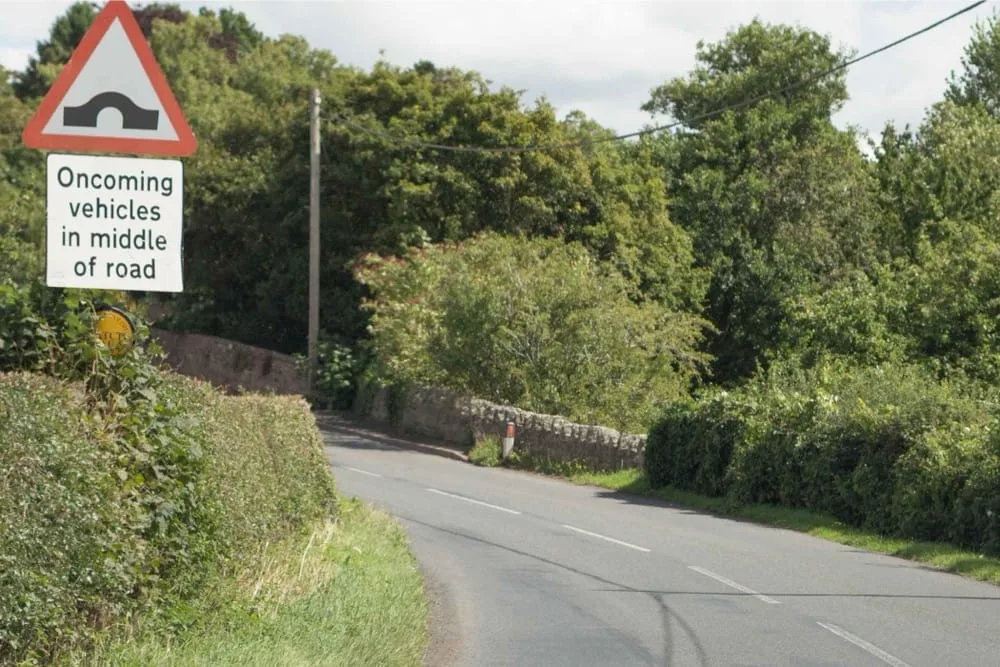
Move to the right
Slow down
Change gear
Keep to 30 mph
Show the answer
Slow downThis was the right answer
You should slow down and be cautious. Hump bridges are often narrow and there may not be enough room for you to pass an oncoming vehicle at this point. Also, there's no footpath, so be aware of pedestrians in the road.
Where should you avoid overtaking?
Just after a bend
In a one-way street
On a dual carriageway
Approaching a dip in the road
Show the answer
Approaching a dip in the roadThis was the right answer
Oncoming vehicles or other hazards can be hidden from view by dips in the road. If you can’t see into the dip, wait until you have a clear view and can see that it's safe before starting to overtake.
What does this curved arrow road marking mean?
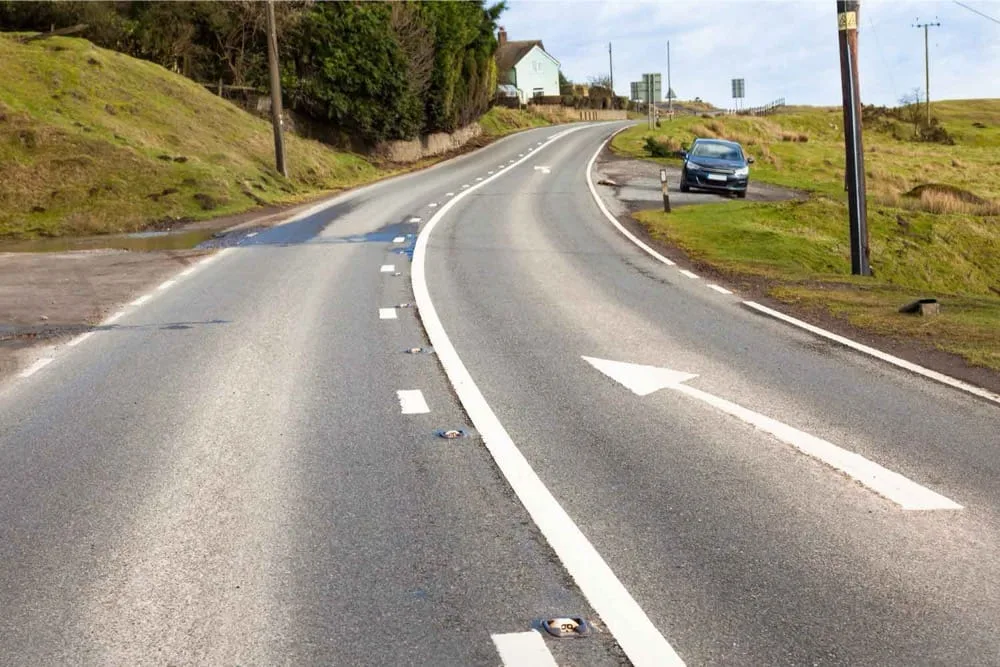
Heavy vehicles should take the next road on the left to avoid a weight limit
The road ahead bends to the left
Overtaking traffic should move back to the left
The road ahead has a camber to the left
Show the answer
Overtaking traffic should move back to the leftThis was the right answer
In this picture, the road marking shows that overtaking drivers or riders need to return to the left. These markings show the direction drivers must pass hatch markings or solid double white lines. They're also used to show the route that high vehicles should take under a low arched bridge.
What should you do if your mobile phone rings while you're driving or riding?
Stop immediately
Answer it immediately
Leave it until you have stopped in a safe place
Pull up at the nearest kerb
Show the answer
Leave it until you have stopped in a safe placeThis was the right answer
It’s illegal to use a hand-held mobile or similar device when driving or riding, except in a genuine emergency. The safest option is to switch off your mobile phone before you set off, and use a message service. If you've forgotten to switch your phone off and it rings, you should leave it. When you've stopped in a safe place, you can see who called and return the call if necessary.
Why are these yellow lines painted across the road?
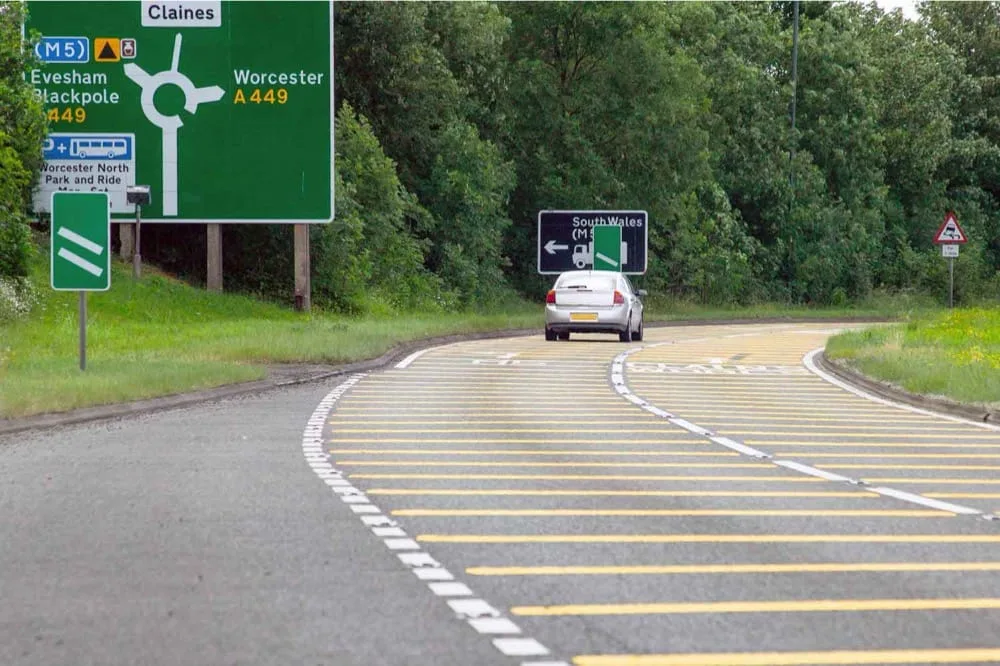
To help you choose the correct lane
To help you keep the correct separation distance
To make you aware of your speed
To tell you the distance to the roundabout
Show the answer
To make you aware of your speedThis was the right answer
These lines are often found on the approach to a roundabout or a dangerous junction. They give you extra warning to adjust your speed. Look well ahead and do this in good time.
What should you do when you're approaching traffic lights that have been green for some time?
Accelerate hard
Maintain your speed
Be ready to stop
Brake hard
Show the answer
Be ready to stopThis was the right answer
The longer traffic lights have been green, the sooner they'll change. Allow for this as you approach traffic lights that you know have been green for a while. They're likely to change soon, so you should be prepared to stop.
What should you do before slowing down or stopping your vehicle?
Sound the horn
Use the mirrors
Select a higher gear
Flash the headlights
Show the answer
Use the mirrorsThis was the right answer
Before slowing down or stopping, check the mirrors to see what's happening behind you. Also assess what's ahead and make sure you give the correct signal if it will help other road users.
You're following a large vehicle. Why should you stay a safe distance behind it?
You'll be able to corner more quickly
You'll help the large vehicle to stop more easily
You'll give the driver a chance to see you in their mirrors
You'll keep out of the wind better
Show the answer
You'll give the driver a chance to see you in their mirrorsThis was the right answer
If you're following a large vehicle but are so close to it that you can't see its exterior mirrors, the driver won't be able to see you. Keeping well back will also allow you to see the road ahead by looking past the large vehicle.
Why should you use your mirrors when you see a hazard ahead?
Because you'll need to accelerate out of danger
To assess how your actions will affect the traffic behind
Because you'll need to brake sharply and stop
To check what's happening on the road ahead
Show the answer
To assess how your actions will affect the traffic behindThis was the right answer
You should be constantly scanning the road for clues about what's going to happen next. Check your mirrors regularly, particularly as soon as you spot a hazard. What's happening behind may affect how you respond to hazards ahead.
You're waiting to turn right at the end of a road. What should you do if your view is obstructed by parked vehicles?
Stop and then move forward slowly and carefully for a clear view
Move quickly to where you can see so you only block traffic from one direction
Wait for a pedestrian to let you know when it's safe for you to emerge
Turn your vehicle around immediately and find another junction to use
Show the answer
Stop and then move forward slowly and carefully for a clear viewThis was the right answer
At junctions, your view is often restricted by buildings, trees or parked cars. You need to be able to see in order to judge a safe gap. Edge forward slowly and keep looking all the time. Don’t cause other road users to change speed or direction as you emerge.
There are objects hanging from your interior mirror. Why could this be a hazard?
Your view could be obstructed
Your sun visor might get tangled
Your radio reception might be affected
Your windscreen could mist up more easily
Show the answer
Your view could be obstructedThis was the right answer
Ensure that you can see clearly through the windscreen of your vehicle. Stickers or hanging objects could obstruct your view or draw your attention away from the road.
You're on a long motorway journey. What should you do if you start to feel sleepy?
Play some loud music
Stop on the hard shoulder for a rest
Drive faster to complete your journey sooner
Leave the motorway and stop in a safe place
Show the answer
Leave the motorway and stop in a safe placeThis was the right answer
If you feel sleepy, you should leave the motorway at a service area or at the next exit and stop in a safe place to rest. A supply of fresh air can help to keep you alert before you reach the exit, but it isn't a substitute for stopping and resting.
Why should you switch your headlights on when it first starts to get dark?
To make your dials easier to see
So others can see you more easily
So that you blend in with other drivers
Because the street lights are lit
Show the answer
So others can see you more easilyThis was the right answer
Your headlights and tail lights help others on the road to see you. It may be necessary to turn on your headlights during the day if visibility is reduced; for example, due to heavy rain. In these conditions, the light might fade before the street lights are timed to switch on. Be seen to be safe.
What’s most likely to distract you while you’re driving?
Using a mobile phone
Using the windscreen wipers
Using the demisters
Using the mirrors
Show the answer
Using a mobile phoneThis was the right answer
Except for emergencies, it’s illegal to use a hand-held mobile phone while you're driving. Even using a hands-free kit can severely distract your attention.
You're driving your car. When may you use a hand-held mobile phone?
When you're receiving a call
When you've parked safely
When you're driving at less than 30 mph
When your car has automatic transmission
Show the answer
When you've parked safelyThis was the right answer
It's illegal to use a hand-held mobile phone while you're driving, except in a genuine emergency. Even using a hands-free kit can distract your attention. Park in a safe and convenient place before receiving or making a call or using text messaging. Then you'll also be free to take notes or refer to papers.
You're driving on a wet road. What should you do if you have to stop your vehicle in an emergency?
Apply the parking brake and footbrake together
Keep both hands on the steering wheel
Select reverse gear
Give an arm signal
Show the answer
Keep both hands on the steering wheelThis was the right answer
As you drive, look well ahead and all around so that you’re ready for any hazards that might develop. If you have to stop in an emergency, react as soon as you can while keeping control of the vehicle. Keep both hands on the steering wheel so you can control the vehicle's direction of travel.
What should you do when you move off from behind a parked car?
Give a signal after moving off
Look around before moving off
Look around after moving off
Use the exterior mirrors only
Show the answer
Look around before moving offThis was the right answer
Before moving off, you should use both the interior and exterior mirrors to check that the road is clear. Look around to check the blind spots and, if necessary, give a signal to warn other road users of your intentions. Also look well ahead as you'll have to steer out into the road to pass the parked car.
You're travelling along this road. How should you pass the cyclist?
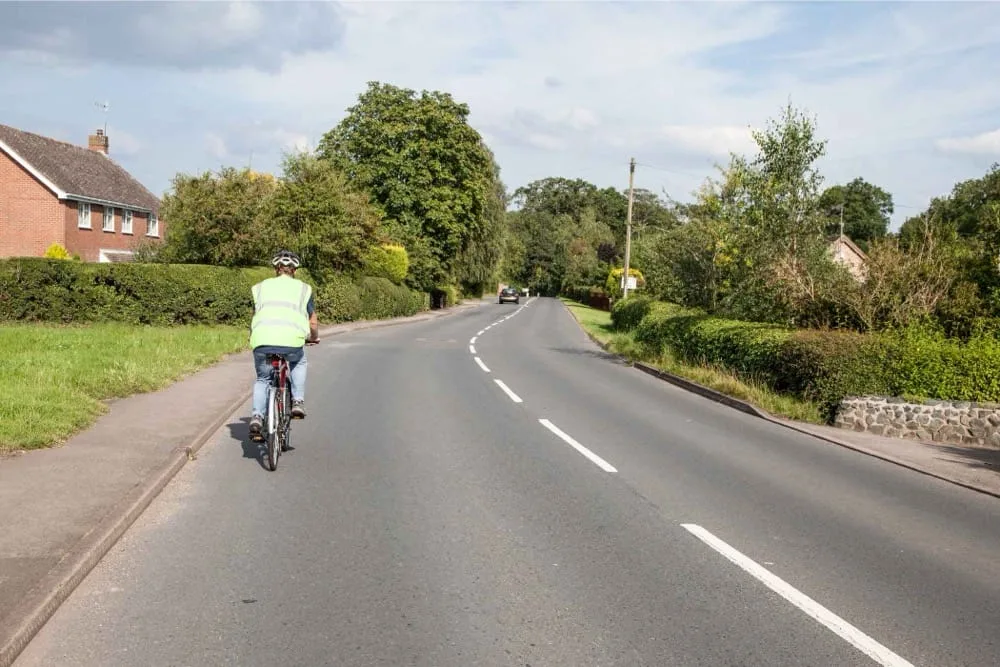
Sound your horn as you pass
Keep close to them as you pass
Leave them plenty of room as you pass
Change down one gear before you pass
Show the answer
Leave them plenty of room as you passThis was the right answer
Allow the cyclist plenty of room in case they wobble or swerve around a pothole or raised drain. Look well ahead before you start to overtake, because you'll need to cross the hazard line. Look for entrances where vehicles could be waiting to pull out.
When do windscreen pillars cause a serious obstruction to your view?
When you're driving on a motorway
When you're driving on a dual carriageway
When you're approaching a one-way street
When you're approaching bends and junctions
Show the answer
When you're approaching bends and junctionsThis was the right answer
Windscreen pillars can obstruct your view, particularly at bends and junctions. Look out for other road users – especially cyclists, motorcyclists and pedestrians who can easily be overlooked.
More car topics
13 moreEvery question in this bank sits in one of these, and each one is a page like this.
Attitude39 questionsEssential documents28 questionsHazard awareness78 questionsIncidents, accidents and emergencies48 questionsMotorway rules57 questionsOther types of vehicle22 questionsRoad and traffic signs133 questionsRules of the road67 questionsSafety and your vehicle77 questionsSafety margins34 questionsVehicle handling45 questionsVehicle loading21 questionsVulnerable road users71 questionsAll car questionsThe whole bank, in 14 topics