Loading the question bank
Motorcycle · DVSA-based revision questions
Rules of the road
52 motorcycle theory test questions on rules of the road. Preview the questions below, or open one to read its answer and continue through the whole topic.
Practise
Be marked as you go
A session draws from all 52 of these, weakest first, and marks each answer the moment you give it. Nothing here needs an account.
The questions
20 of 52The first 20 in the order the pack holds them. Open the answer when you want to check yourself; a session draws from all 52 and marks you instead.
You're riding slowly in a town centre. Why should you glance over your left shoulder before turning left?
To check for cyclists
To help keep your balance
To look for traffic signs
To check for potholes
Show the answer
To check for cyclistsThis was the right answer
When riding slowly, you must remember to look out for cyclists - they can travel quickly and fit through surprisingly narrow spaces. Before you turn left in slow-moving traffic, it's important to check that a cyclist isn't trying to filter past on your left.
Which lane must not be used by a motorcyclist?
Crawler lane
Overtaking lane
Acceleration lane
Tram lane
Show the answer
Tram laneThis was the right answer
Always plan ahead and be aware of lanes and areas designated for specific road users only. The restrictions are sometimes in force only at certain times of day, and signs will show when they apply. In some towns, motorcycles are permitted to use bus lanes – check the signs carefully.
What does this sign mean?
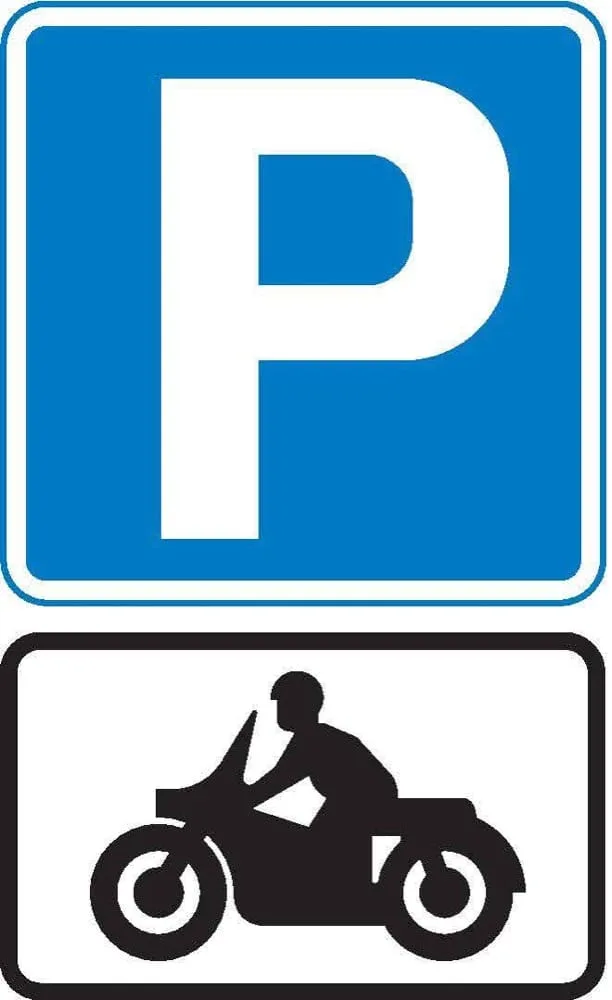
No parking for solo motorcycles
Parking for solo motorcycles
Passing place for motorcycles
Police motorcycles only
Show the answer
Parking for solo motorcyclesThis was the right answer
In some towns and cities there are special areas reserved for parking motorcycles. Look out for these signs.
You're riding on a busy dual carriageway. What should you do before you change lanes?
Rely totally on your mirrors
Always increase your speed
Signal so that others will give way
Use mirrors and shoulder checks
Show the answer
Use mirrors and shoulder checksThis was the right answer
Before changing direction, as well as using your mirrors, you may need to take a quick sideways glance to check for vehicles in your blind spots. These are the areas behind and to the side of you that aren't covered by your mirrors.
You're looking for somewhere to park your motorcycle. Neither you or your passenger are disabled. What should you do if the area is full, except for spaces marked ‘disabled use’?
Use one of these spaces because elsewhere is full
Park in one of these spaces but stay with your motorcycle
Use one of the spaces as long as one is kept free
Wait for a regular parking space to become free
Show the answer
Wait for a regular parking space to become freeThis was the right answer
It's illegal to park in a space reserved for disabled users unless you're permitted to do so. These spaces are provided for people with limited mobility, who may need extra space to get in and out of their vehicle.
You're on a narrow road with passing places. What should you do if a car is coming towards you?
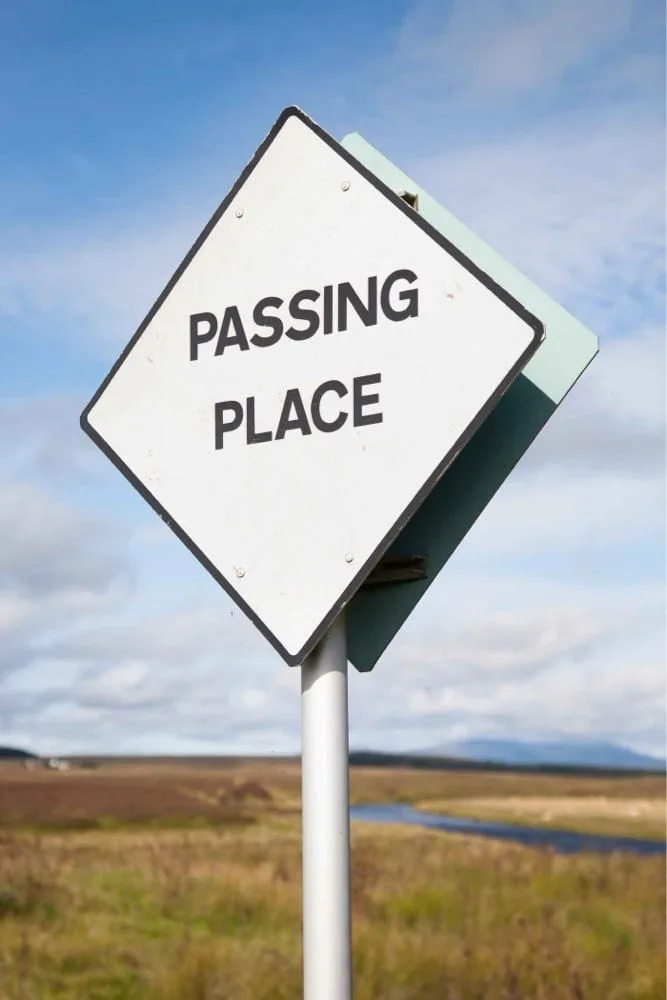
Pull into a passing place on your right
Force the other driver to reverse
Turn round and ride back to the main road
Pull into a passing place on your left
Show the answer
Pull into a passing place on your leftThis was the right answer
If you meet another vehicle on a narrow road and the passing place is on your left, pull into it. If the passing place is on your right, wait opposite it.
You're turning right at this crossroads. The oncoming driver is also turning right. Why is it safer to turn behind the car?
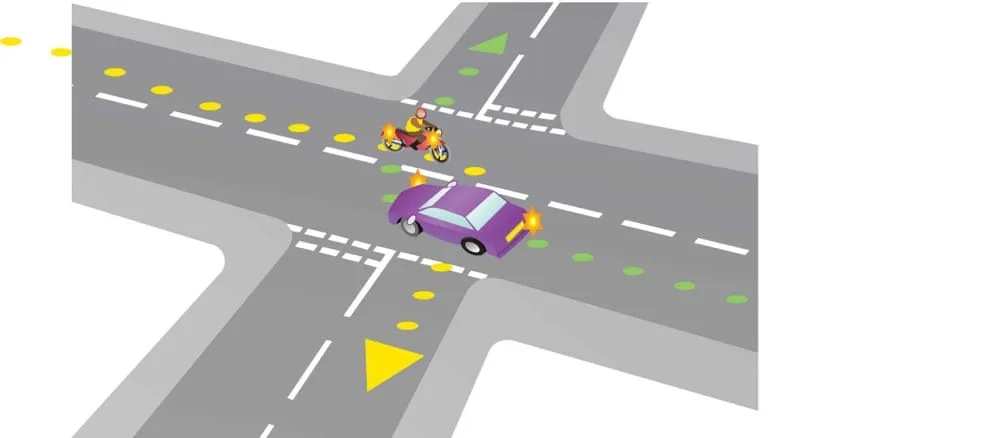
So you can see approaching traffic
So you can keep close to the kerb
So you can keep clear of following traffic
So you can make oncoming vehicles stop
Show the answer
So you can see approaching trafficThis was the right answer
When turning right at this crossroads, keeping the oncoming car to your right will give you a clear view of the road ahead.
What should you do when you're filtering through slow-moving or stationary traffic?
Watch for vehicles emerging from side roads
Continually use your horn as a warning
Stand up on the footrests for a good view ahead
Ride with your hazard warning lights on
Show the answer
Watch for vehicles emerging from side roadsThis was the right answer
Other road users may not expect or look for motorcycles filtering through slow-moving or stationary traffic. Your view will be reduced by the vehicles around you. Watch out for pedestrians walking between the vehicles, vehicles changing direction and vehicles turning into or out of side roads.
You're riding towards roadworks where temporary traffic lights are on red. What should you do if the road ahead is clear?
Ride on with extreme caution
Ride on at normal speed
Carry on if approaching cars have stopped
Wait for the green light
Show the answer
Wait for the green lightThis was the right answer
You must obey all traffic signs and signals. Just because the lights are temporary, it doesn't mean that you can disregard them.
Your UK motorcycle has a left-dipping headlamp with no travel setting, and its handbook specifies external beam deflectors for riding on the right. What should you fit?
Twin headlights
Headlight deflectors
Tinted yellow brake lights
Tinted red indicator lenses
Show the answer
Headlight deflectorsThis was the right answer
A left-dipping beam can dazzle oncoming traffic when riding on the right. On a motorcycle whose handbook specifies external deflectors, fit the correct ones as directed. Some machines instead have a built-in beam adjustment or another approved arrangement; check the handbook before travelling.
What's the minimum engine size required to tow a trailer with your motorcycle?
50 cc
125 cc
525 cc
1000 cc
Show the answer
125 ccThis was the right answer
Towing a trailer requires special care. You must obey the restrictions that apply when towing - including the 125 cc minimum size of your motorcycle engine and the reduced national speed limits. Don't forget the trailer is there, especially when negotiating bends and junctions.
What's the national speed limit for a motorcycle without a trailer on a single carriageway?
40 mph
50 mph
60 mph
70 mph
Show the answer
60 mphThis was the right answer
The national maximum is 60 mph for a motorcycle not towing on a single carriageway. A motorcycle towing a trailer is limited to 50 mph. Follow any lower signed limit and ride more slowly whenever road, weather or traffic conditions require.
When must you stop your motorcycle?
At a clear pelican crossing when the amber light is flashing
At an empty zebra crossing
When signalled to do so by a police officer
At a junction with double broken white lines
Show the answer
When signalled to do so by a police officerThis was the right answer
Don't stop or hold up traffic unnecessarily. However, there are occasions when you must stop by law. These include
* when signalled to do so by a school crossing patrol, police officer or traffic officer
* at a red traffic light
* at a junction with a 'stop' sign.
What's the meaning of this sign?
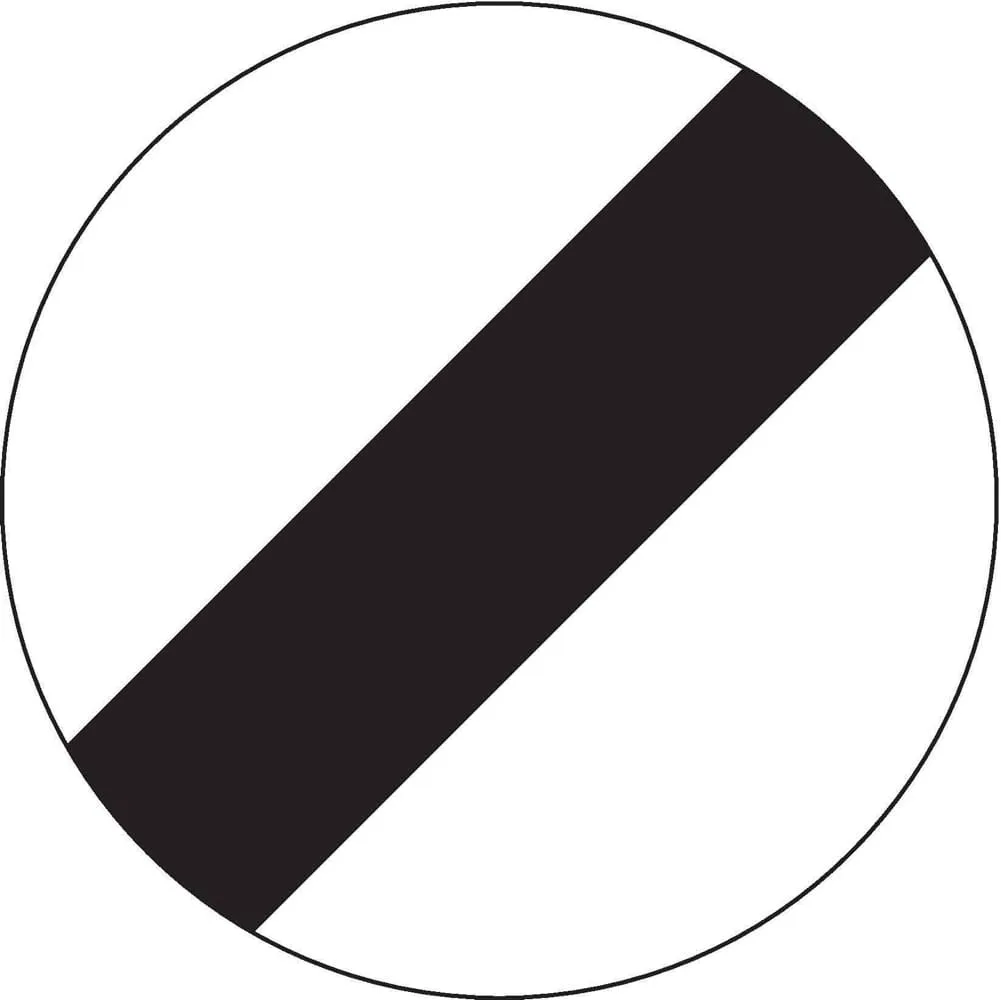
Local speed limit applies
No waiting on the carriageway
National speed limit applies
No entry for vehicles
Show the answer
National speed limit appliesThis was the right answer
This sign doesn't tell you the speed limit in figures. You should know the speed limit for the type of road that you're on and the type of vehicle that you're driving or riding. Study your copy of The Highway Code.
What's the national speed limit for cars and motorcycles on a dual carriageway?
30 mph
50 mph
60 mph
70 mph
Show the answer
70 mphThis was the right answer
Make sure that you know the speed limit for the road that you're on. The speed limit on a dual carriageway or motorway is 70 mph for cars and motorcycles, unless signs indicate otherwise. The speed limits for different types of vehicle are listed in The Highway Code.
There are no speed-limit signs on the road. In England, Scotland and Northern Ireland how is a 30 mph limit generally indicated?
By hazard warning lines
By street lighting
By pedestrian islands
By double or single yellow lines
Show the answer
By street lightingThis was the right answer
In England, Scotland and Northern Ireland, there's a 30 mph speed limit where there are street lights unless signs show another limit.
In Wales street lights indicate the limit is 20 mph unless signs show otherwise.
In England, Scotland and Northern Ireland what will the speed limit usually be where you can see street lights but no speed-limit signs?
30 mph
40 mph
50 mph
60 mph
Show the answer
30 mphThis was the right answer
In England, Scotland and Northern Ireland the presence of street lights generally indicates that there's a 30 mph speed limit, unless signs tell you otherwise.
In Wales street lights indicate a 20 mph limit unless signs show otherwise.
What does this sign mean?
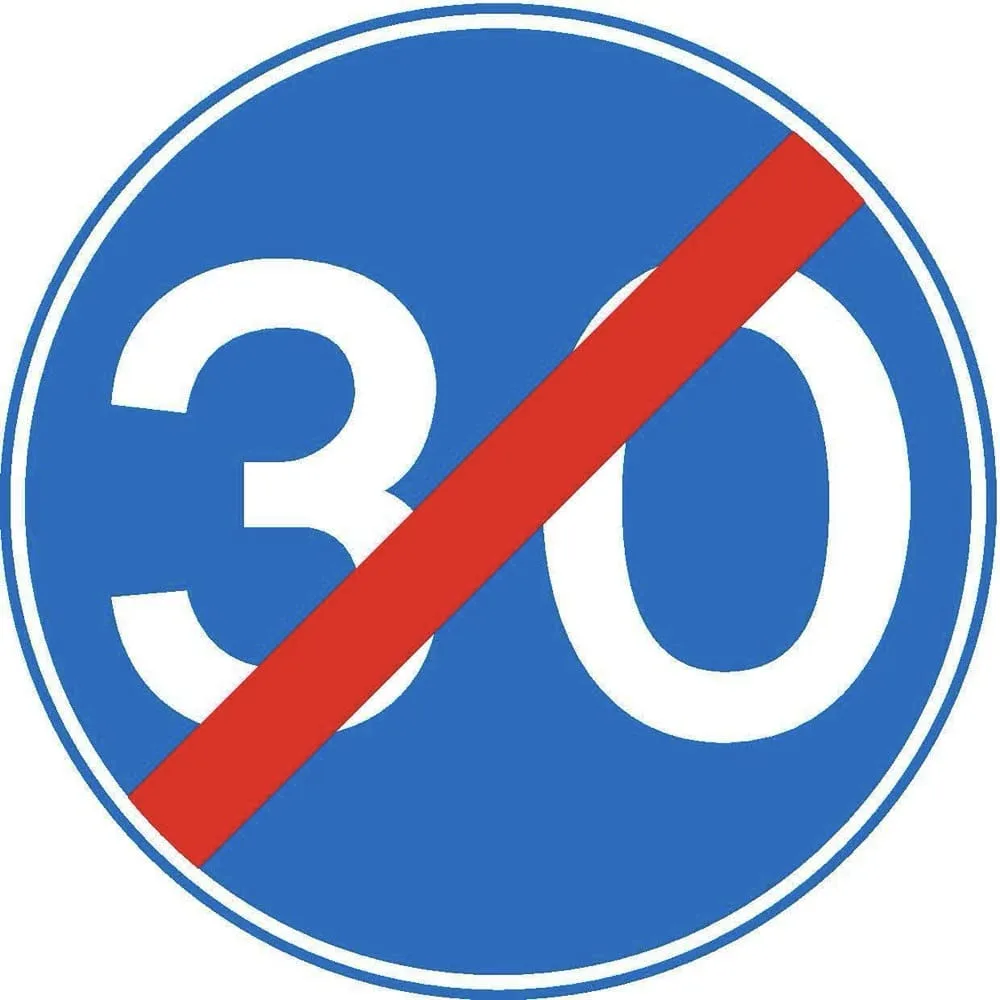
Minimum speed 30 mph
End of maximum speed
End of minimum speed
Maximum speed 30 mph
Show the answer
End of minimum speedThis was the right answer
The red slash through the sign indicates that the restriction has ended. In this case, the restriction was a minimum speed limit of 30 mph.
What should you do if you want to overtake a tractor but aren't sure that it's safe?
Follow another vehicle as it overtakes the tractor
Sound your horn to make the tractor driver pull over
Speed past, flashing your lights at oncoming traffic
Stay behind it if you're in any doubt
Show the answer
Stay behind it if you're in any doubtThis was the right answer
Following a tractor can be frustrating, but never overtake if you’re unsure whether it’s safe. Ask yourself: 'Can I see far enough down the road to ensure that I can complete the manoeuvre safely?' It's better to be delayed for a minute or two than to take a chance that may cause a collision.
Which vehicle is most likely to take an unusual course at a roundabout?
Estate car
Taxi
Delivery van
Long vehicle
Show the answer
Long vehicleThis was the right answer
Long vehicles might have to take a slightly different position when approaching the roundabout or going around it. This is to stop the rear of the vehicle cutting in and mounting the kerb.
More motorcycle topics
13 moreEvery question in this bank sits in one of these, and each one is a page like this.
Alertness33 questionsAttitude28 questionsEssential documents32 questionsHazard awareness51 questionsIncidents, accidents and emergencies38 questionsMotorcycle handling51 questionsMotorcycle loading32 questionsMotorway rules51 questionsOther types of vehicle17 questionsRoad and traffic signs134 questionsSafety and your motorcycle79 questionsSafety margins38 questionsVulnerable road users67 questionsAll motorcycle questionsThe whole bank, in 14 topics