Loading the question bank
Motorcycle · DVSA-based revision questions
Motorway rules
51 motorcycle theory test questions on motorway rules. Preview the questions below, or open one to read its answer and continue through the whole topic.
Practise
Be marked as you go
A session draws from all 51 of these, weakest first, and marks each answer the moment you give it. Nothing here needs an account.
The questions
20 of 51The first 20 in the order the pack holds them. Open the answer when you want to check yourself; a session draws from all 51 and marks you instead.
When may you stop on the hard shoulder of a motorway?
In an emergency
If you feel tired and need to rest
If you've gone past your exit
To answer your mobile phone
Show the answer
In an emergencyThis was the right answer
You mustn't stop on the hard shoulder, except in an emergency or when your motorcycle breaks down. If the hard shoulder is in use as a running lane, try to reach an emergency area or take the next exit. Never use the hard shoulder to have a rest or a picnic, answer a mobile phone or check a road map.
You're riding on the motorway. Where should you position your motorcycle well before you reach your exit slip-road?
In the middle lane
In the left-hand lane
On the hard shoulder
In any lane
Show the answer
In the left-hand laneThis was the right answer
You’ll see the first advance direction sign one mile from a motorway exit. If you’re travelling at 60 mph, you’ll only have about 50 seconds before you reach the countdown markers. There'll be another sign at the half-mile point. Move to the left-hand lane in good time. Don’t cut across traffic at the last moment and don’t risk missing your exit.
What should you do if you're joining a motorway from a slip road?
Adjust your speed to match the speed of the traffic on the motorway
Accelerate as quickly as you can and ride straight out
Ride onto the hard shoulder until a gap appears
Expect drivers on the motorway to give way to you
Show the answer
Adjust your speed to match the speed of the traffic on the motorwayThis was the right answer
Give way to vehicles that are already on the motorway, and join the left-hand lane when there’s a suitable gap in the traffic. Don’t expect traffic on the motorway to give way to you, but try to avoid stopping at the end of the slip road.
What's the minimum engine size your motorcycle must have, if you want to ride it on the motorway?
50 cc
125 cc
150 cc
250 cc
Show the answer
50 ccThis was the right answer
Riders of motorcycles with an engine smaller than 50 cc aren't allowed to use motorways, due to their restricted speed. They may cause a hazard – both for the rider and for drivers of other vehicles.
You're riding at 70 mph on a three-lane motorway. Which lane should you use if there's no traffic ahead?
Any lane
The middle lane
The right-hand lane
The left-hand lane
Show the answer
The left-hand laneThis was the right answer
If you're not overtaking, use the left-hand lane regardless of the speed at which you’re travelling.
You're riding a motorcycle without a trailer on a motorway. Unless signs show otherwise, what's the national speed limit?
50 mph
60 mph
70 mph
80 mph
Show the answer
70 mphThis was the right answer
The national speed limit of 70 mph applies to cars and motorcycles on the motorway, unless they're towing a trailer. This speed limit can be reduced and signs will show the new speed limit inside a red circle.
Why is it particularly important to carry out a check of your motorcycle before making a long motorway journey?
You'll have to do more harsh braking on motorways
Motorway service stations don't deal with breakdowns
The road surface will wear down the tyres faster
Continuous high speeds increase the risk of your motorcycle breaking down
Show the answer
Continuous high speeds increase the risk of your motorcycle breaking downThis was the right answer
Before starting a motorway journey, make sure your motorcycle can cope with the demands of high-speed riding. Things you need to check include oil, water, tyres and fuel. When you're travelling a long way, it's a good idea to plan rest stops in advance.
You're joining a motorway from a slip road. How should you deal with traffic already on the motorway?
Carry on along the hard shoulder until you see a safe gap
Stop at the end of the slip road and look for a safe gap
Use the slip road to accelerate until you're moving much faster than the motorway traffic
Match your speed to traffic in the left-hand lane and filter into a safe gap
Show the answer
Match your speed to traffic in the left-hand lane and filter into a safe gapThis was the right answer
You should give way to traffic already on the motorway. Where possible, traffic may move over to let you in, but don’t force your way into the traffic stream. Traffic could be travelling at high speed, so try to match your speed to filter in without affecting the traffic flow.
What's the national speed limit on motorways for cars and motorcycles?
30 mph
50 mph
60 mph
70 mph
Show the answer
70 mphThis was the right answer
Travelling at the national speed limit doesn't allow you to hog the right-hand lane. Always use the left-hand lane whenever possible. When leaving a motorway, get into the left-hand lane well before your exit. Reduce your speed on the slip road and look out for sharp bends or curves and traffic queuing at roundabouts.
Which vehicles should use the left-hand lane on a three-lane motorway?
Any vehicle that isn't overtaking
Large vehicles only
Emergency vehicles only
Slow vehicles only
Show the answer
Any vehicle that isn't overtakingThis was the right answer
On a motorway, all traffic should use the left-hand lane unless overtaking. When overtaking a number of slower vehicles, move back to the left-hand lane when you’re safely past. Check your mirrors frequently and don’t stay in the middle or right-hand lane if the left-hand lane is free.
Which vehicles aren't allowed to use the right-hand lane of a three-lane motorway?
Small delivery vans
Motorcycles
Vehicles towing a trailer
Motorcycle and sidecar outfits
Show the answer
Vehicles towing a trailerThis was the right answer
On the motorway, any vehicle towing a trailer is restricted to 60 mph. It’s not allowed in the right-hand lane, as it might hold up faster-moving traffic that wishes to overtake in that lane.
Your vehicle breaks down on a motorway and you need to call for help. Why might it be better to use an emergency roadside telephone rather than a mobile phone?
It connects you to a local garage
Using a mobile phone will distract other drivers
It allows easy location by the emergency services
Mobile phones don't work on motorways
Show the answer
It allows easy location by the emergency servicesThis was the right answer
On a motorway, it's best to use a roadside emergency telephone so that the emergency services are able to find you easily. The location of the nearest telephone is shown by an arrow on marker posts at the edge of the hard shoulder. If you use a mobile, find out the number on the nearest marker post before you call. This number will let the operator know where you are and in which direction you're travelling.
Your vehicle broke down on the hard shoulder of a motorway, but has now been repaired. How should you rejoin the main carriageway?
Move out onto the carriageway, then build up your speed
Move out onto the carriageway using your hazard warning lights
Gain speed on the hard shoulder before moving out onto the carriageway
Wait on the hard shoulder until someone flashes their headlights at you
Show the answer
Gain speed on the hard shoulder before moving out onto the carriagewayThis was the right answer
Signal your intention and build up sufficient speed on the hard shoulder so that you can filter into a safe gap in the traffic. Don't push your way into a small gap or cause other traffic to alter speed or direction.
You're travelling along a motorway. Where would you find a crawler or climbing lane?
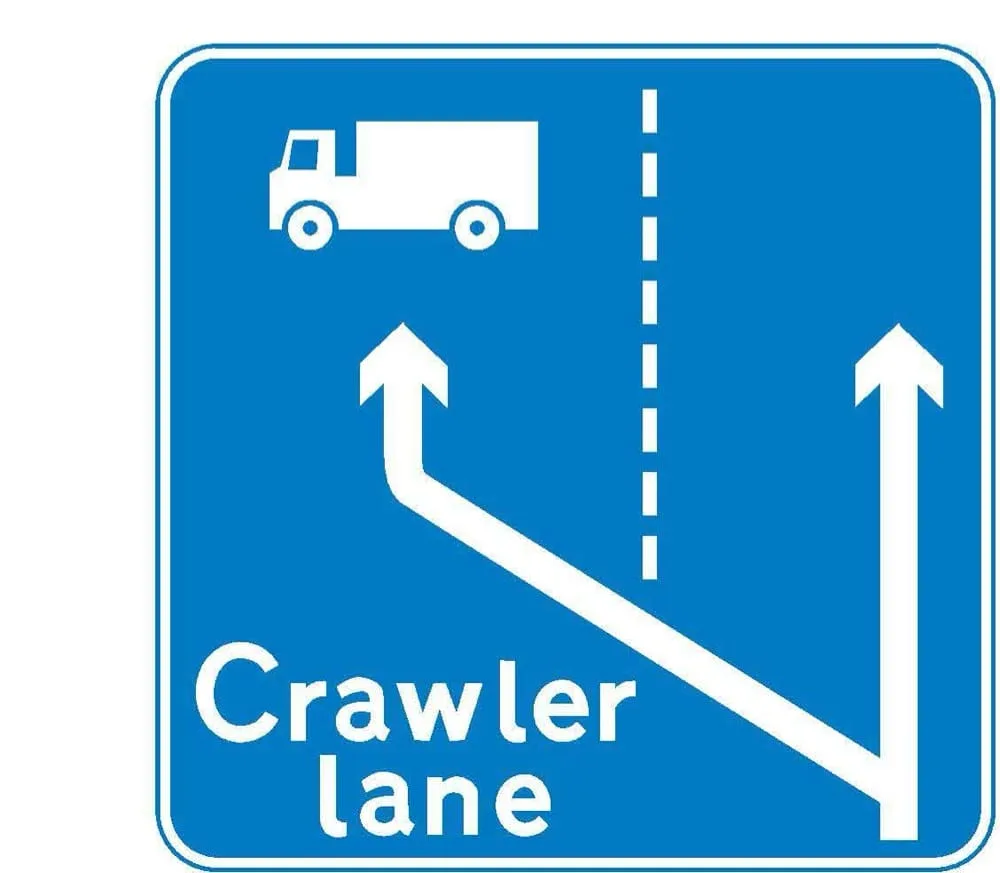
On a steep gradient
Before a service area
Before a junction
Along the hard shoulder
Show the answer
On a steep gradientThis was the right answer
Large, slow-moving vehicles can hinder the progress of other traffic. On a steep gradient, an extra crawler lane may be provided for slow-moving vehicles to allow faster-moving traffic to flow more easily.
What do these motorway signs mean?

They're countdown markers to a bridge
They're distance markers to the next telephone
They're countdown markers to the next exit
They warn of a police control ahead
Show the answer
They're countdown markers to the next exitThis was the right answer
The exit from a motorway is indicated by countdown markers. These are positioned 90 metres (100 yards) apart, the first being 270 metres (300 yards) from the start of the slip road. Move into the left-hand lane well before you reach the start of the slip road.
Where are amber reflective studs found on a motorway?
Between the hard shoulder and the carriageway
Between the acceleration lane and the carriageway
Between the central reservation and the carriageway
Between each pair of lanes
Show the answer
Between the central reservation and the carriagewayThis was the right answer
On motorways, reflective studs of various colours are fixed in the road between the lanes. These help you to identify which lane you're in when it's dark or in poor visibility. Amber-coloured studs are found on the right-hand edge of the main carriageway, next to the central reservation.
What colour are the reflective studs between the lanes on a motorway?
Green
Amber
White
Red
Show the answer
WhiteThis was the right answer
White studs are found between the lanes on motorways. They reflect back the light from your headlights. This is especially useful in bad weather, when visibility is restricted.
What colour are the reflective studs between a motorway and a slip road?
Amber
White
Green
Red
Show the answer
GreenThis was the right answer
The studs between the carriageway and the hard shoulder are normally red. These change to green where there's a slip road, helping you to identify slip roads when visibility is poor or when it's dark.
Your vehicle has broken down on a motorway. In which direction should you walk to find the nearest emergency telephone?
With the traffic flow
Facing oncoming traffic
In the direction shown on the marker posts
In the direction of the nearest exit
Show the answer
In the direction shown on the marker postsThis was the right answer
Along the hard shoulder there are marker posts at 100-metre intervals. These will direct you to the nearest emergency telephone.
Why is it important to make full use of the slip road as you join a motorway?
Because there's space available to turn round if you need to
To allow you direct access to the overtaking lanes
To allow you to fit safely into the traffic flow in the left-hand lane
Because you can continue on the hard shoulder
Show the answer
To allow you to fit safely into the traffic flow in the left-hand laneThis was the right answer
Try to join the motorway without affecting the progress of the traffic in the left-hand lane and always give way to traffic already on the motorway. At busy times, you may have to slow down to merge into slow-moving traffic.
More motorcycle topics
13 moreEvery question in this bank sits in one of these, and each one is a page like this.
Alertness33 questionsAttitude28 questionsEssential documents32 questionsHazard awareness51 questionsIncidents, accidents and emergencies38 questionsMotorcycle handling51 questionsMotorcycle loading32 questionsOther types of vehicle17 questionsRoad and traffic signs134 questionsRules of the road52 questionsSafety and your motorcycle79 questionsSafety margins38 questionsVulnerable road users67 questionsAll motorcycle questionsThe whole bank, in 14 topics