Loading the question bank
Driving instructor · DVSA-based revision questions
Band 3 driving test, disabilities, law
132 ADI part one theory test questions on band 3 driving test, disabilities, law. Preview the questions below, or open one to read its answer and continue through the whole topic.
Practise
Be marked as you go
A session draws from all 132 of these, weakest first, and marks each answer the moment you give it. Nothing here needs an account.
The questions
20 of 132The first 20 in the order the pack holds them. Open the answer when you want to check yourself; a session draws from all 132 and marks you instead.
How should you park when you leave your vehicle overnight on a road that has a 40 mph speed limit?
Facing the traffic
With parking lights on
With dipped headlights on
Near a street light
Show the answer
With parking lights onThis was the right answer
All vehicles must display parking lights when parked on a road with a speed limit greater than 30 mph. Park in the direction of the traffic flow so that your parked vehicle isn't mistaken for a moving vehicle.
Which vehicles aren't allowed in the right-hand lane of a three-lane motorway?
Vans
Motorcycles
Vehicles towing a trailer or caravan
Motorcycles fitted with a sidecar
Show the answer
Vehicles towing a trailer or caravanThis was the right answer
A 60 mph speed limit applies to a vehicle towing a trailer on a motorway; such a vehicle is also not allowed in the right-hand lane of a motorway that has more than two lanes.
Where is parking prohibited?
In a one-way street
Near a police station
In a side road
On zigzag lines near a pedestrian crossing
Show the answer
On zigzag lines near a pedestrian crossingThis was the right answer
Parking near a pedestrian crossing creates an obstruction that prevents both drivers and pedestrians from having a clear view. Careless parking is selfish and could endanger other road users.
You're driving at night. When can you park on the right-hand side of a road?
When you park in a one-way street
When you park with your offside parking lights switched on
When you park less than 10 metres (32 feet) from a junction
When you park under a lamppost
Show the answer
When you park in a one-way streetThis was the right answer
Red rear reflectors show up when headlights shine on them. These are useful when you're parked at night but will only reflect if you park in the same direction as the traffic flow. Normally you should park on the left, but if you're in a one-way street you may also park on the right-hand side.
This sign gives advance notice that a temporary 50 mph limit starts three-quarters of a mile ahead. What must you do when you reach the start of the signed limit?
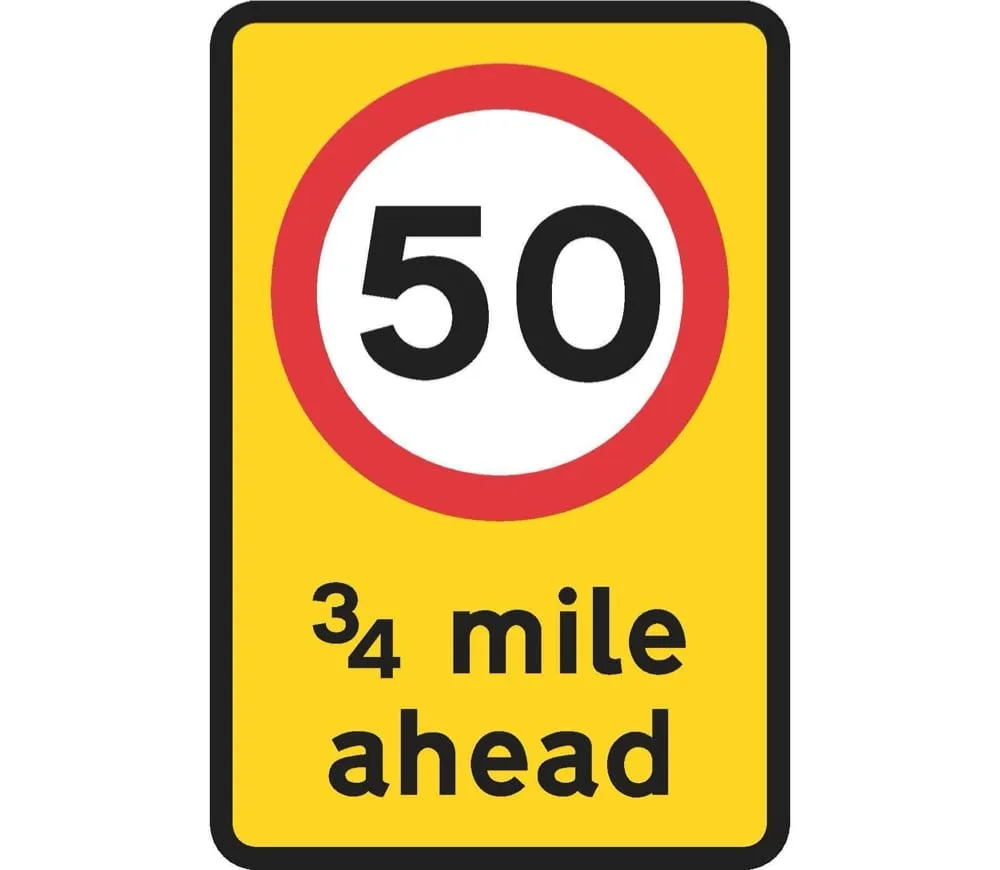
Not exceed the speed limit
Obey the limit only during rush hour
Treat the speed limit as advisory
Obey the limit except for overnight
Show the answer
Not exceed the speed limitThis was the right answer
The plate makes this an advance warning: the mandatory 50 mph restriction starts at the later red-ring speed-limit sign, not where this advance sign stands. From that point, do not exceed the limit until it ends or another signed limit applies. Slow in good time for the roadworks and any earlier hazard.
For how long is an MOT certificate normally valid?
Three years
10,000 miles
One year
30,000 miles
Show the answer
One yearThis was the right answer
An MOT certificate will normally be valid for one year. The certificate doesn't warrant the condition of the vehicle at a later date, but simply shows that at the time the certificate was issued the vehicle met the MOT requirements. It's the driver's responsibility to ensure that the vehicle is roadworthy whenever it's driven.
What's a cover note?
A driving licence
A temporary insurance certificate
A registration document
An MOT certificate
Show the answer
A temporary insurance certificateThis was the right answer
Sometimes an insurance company will issue a temporary insurance certificate called a cover note. It gives you the same insurance cover as your certificate, but lasts for a limited period, usually one month.
What's the nearest you may park to a junction?
10 metres (32 feet)
12 metres (39 feet)
15 metres (49 feet)
20 metres (66 feet)
Show the answer
10 metres (32 feet)This was the right answer
Don't park within 10 metres (32 feet) of a junction (unless in an authorised parking place). This is to allow drivers emerging from, or turning into, the junction a clear view of the road they're joining. It also allows them to see hazards such as pedestrians or cyclists at the junction.
Your vehicle is stationary in traffic. When are you allowed to use the horn?
When a moving vehicle may cause you danger
At any time you wish
If your hazard warning lights aren't working
To signal that you're in a hurry
Show the answer
When a moving vehicle may cause you dangerThis was the right answer
If your vehicle is stationary, only sound the horn if you think there's a risk of danger. Don't use it to attract attention. This causes unnecessary noise and could be misleading to other road users.
Which vehicles aren't allowed to use the right-hand lane of a three-lane motorway?
Motorcycles
Vehicles under 3.5 tonnes
Vehicles towing a trailer
People carriers with seven seats
Show the answer
Vehicles towing a trailerThis was the right answer
Vehicles towing trailers are subject to a speed limit of 60 mph on motorways and dual carriageways. In addition, any vehicle towing a trailer may not use the right-hand lane of a motorway that has three or more lanes.
A car is fitted with dual accelerator, clutch and brake pedals. Which of the pedals must be removed before the car can be used for a driving test?
Clutch and brake
Accelerator and clutch
Clutch
Accelerator
Show the answer
AcceleratorThis was the right answer
Dual accelerators aren't normally fitted to training vehicles. If one is fitted, it must be removed while the vehicle is being used for a driving test.
For how long does a driving-test pass certificate remain valid?
1 year
2 years
3 years
10 years
Show the answer
2 yearsThis was the right answer
When a candidate passes a practical driving test, their full licence is normally issued directly by the licensing authority. However, if this doesn't happen, successful candidates should apply for a full licence as soon as possible. The driving-test pass certificate is valid for two years; if a full licence isn't applied for within that time, the driver will need to retake their test.
Drivers convicted of certain dangerous driving offences are required to take an extended driving test. How does the extended test differ from the standard driving test?
It's the same length of time as the standard driving test but includes additional manoeuvres
It takes about 70 minutes and includes additional manoeuvres
It takes about 70 minutes but includes the same manoeuvres as the standard driving test
It's focused on the cause of the candidate's conviction
Show the answer
It takes about 70 minutes but includes the same manoeuvres as the standard driving testThis was the right answer
The extended test takes about 70 minutes and is assessed to the same level as the standard driving test for learner drivers.
When will an approved driving instructor (ADI) be subject to standards checks?
Only for the first 6 months that they're on the register
For the whole time that they're on the register
Only for the first 12 months that they're on the register
Only until they achieve a Grade A
Show the answer
For the whole time that they're on the registerThis was the right answer
As part of the regulations, an ADI must undergo at least one standards check during each four-year period that they're on the register. The standards check should be approached with a positive attitude and looked upon as a development opportunity.
What rules apply to anyone who accompanies a learner driver while they drive on the road?
They must be at least 21, qualified for that vehicle and have held an eligible full licence for at least 3 years
They must have held a full EC/EEA licence for the category of vehicle being driven for at least 3 years and they must be at least 25 years old
They must have held a full EC/EEA licence for the category of vehicle being driven for at least 4 years and they must be at least 21 years old
They must have held a full EC/EEA licence for the category of vehicle being driven for at least 4 years and they must be at least 25 years old
Show the answer
They must be at least 21, qualified for that vehicle and have held an eligible full licence for at least 3 yearsThis was the right answer
A supervisor must be at least 21, qualified to drive the type of vehicle and have held the relevant full licence for at least three years. The current eligible-licence list covers the UK, EU, Switzerland, Norway, Iceland and Liechtenstein. The supervisor must also be legally fit to drive and use no hand-held phone while supervising.
At what age does a passenger become responsible for fastening their own seat belt?
14 years old
15 years old
16 years old
18 years old
Show the answer
14 years oldThis was the right answer
It's the driver's legal responsibility to ensure that all passengers under 14 years old wear a seat belt, or are fastened in an approved child restraint. However, it's good practice to ensure that all other passengers wear seat belts as well.
You're driving at night on a road that has a 30 mph speed limit. You find somewhere to park near a junction. How close to the junction are you allowed to park?
10 metres (32 feet)
15 metres (50 feet)
20 metres (66 feet)
25 metres (82 feet)
Show the answer
10 metres (32 feet)This was the right answer
Don't park less than 10 metres (32 feet) from a junction (unless in an authorised parking place). At night, park in the direction of the traffic, so that your car's red reflectors show to passing drivers. You must use your parking lights when parking at night on a road, or in a lay-by on a road, where the speed limit is over 30 mph.
At what age does category B driving entitlement normally expire?
On your 60th birthday
On your 65th birthday
On your 70th birthday
On your 75th birthday
Show the answer
On your 70th birthdayThis was the right answer
A category B driving entitlement is normally valid until a person's 70th birthday. The new photocard licence needs to be updated every 10 years; this is to keep the photograph up to date.
Your pupil, who is profoundly deaf, intends to apply for a driving test. What advice should you give them about their application?
Declare their deafness on the application form
Complete an application form for a special test
Complete an application form for an extended test
Don't declare their deafness
Show the answer
Declare their deafness on the application formThis was the right answer
The Driver and Vehicle Standards Agency will need to know that your pupil is profoundly deaf to make the appropriate booking arrangements. This should be recorded when booking the test. Approved driving instructors should be able to help any pupil with their application for a theory test or a practical driving test.
What's the minimum driving age for a person receiving the enhanced rate of the mobility component of Personal Independence Payment?
15 years
16 years
17 years
21 years
Show the answer
16 yearsThis was the right answer
A 16 year old may drive a car if they're in receipt of the enhanced rate of the mobility component of Personal Independence Payment. However, if the enhanced rate is withdrawn, the normal minimum age for driving a car (17 years old) will then apply.
More driving instructor topics
3 moreEvery question in this bank sits in one of these, and each one is a page like this.