Loading the question bank
Driving instructor · DVSA-based revision questions
Band 1 road procedure
316 ADI part one theory test questions on band 1 road procedure. Preview the questions below, or open one to read its answer and continue through the whole topic.
Practise
Be marked as you go
A session draws from all 316 of these, weakest first, and marks each answer the moment you give it. Nothing here needs an account.
The questions
20 of 316The first 20 in the order the pack holds them. Open the answer when you want to check yourself; a session draws from all 316 and marks you instead.
How must you treat a pelican crossing that crosses the road in a straight line and has a central island?
As one crossing in daylight only
As one complete crossing
As two separate crossings
As two crossings during darkness
Show the answer
As one complete crossingThis was the right answer
The lights that control the crossing show to both directions of traffic. If a pedestrian from either side is still crossing when the amber light is flashing, you must wait.
You want to turn into the next side road on the left. What should you do if you're following a cyclist as you approach the junction?
Keep following the cyclist and turn behind them
Overtake the cyclist briskly and turn in front of them
Sound your horn to warn the cyclist you want to turn
Allow extra room when you overtake the cyclist, so that you can turn across them easily
Show the answer
Keep following the cyclist and turn behind themThis was the right answer
If you want to turn left and there's a cyclist in front of you, hold back. Wait until the cyclist has passed the junction and then turn left behind them.
What should you do if you wish to overtake a long, slow-moving vehicle on a busy road?
Follow it closely and keep moving out to see the road ahead
Flash your headlights for the oncoming traffic to give way
Stay behind until the driver waves you past
Keep well back until you can see that it's clear
Show the answer
Keep well back until you can see that it's clearThis was the right answer
If you wish to overtake a long vehicle, stay well back so that you can see the road ahead. Don't
• get too close to the vehicle, as this will restrict your view of the road ahead
• get impatient; overtaking on a busy road calls for sound judgement
• take a gamble; only overtake when you can see that you can safely complete the manoeuvre.
Who has priority at a crossroads where there are no signs or road markings?
No-one
The vehicle travelling the fastest
Oncoming vehicles turning right
Vehicles approaching from the right
Show the answer
No-oneThis was the right answer
At a crossroads where there are no 'give way' signs or road markings, no-one has priority, even if the roads are of different sizes. Approach slowly and only cross when the junction is clear.
Why should you keep well back when you're following a large vehicle?
To prevent diesel exhaust particles from being sucked into your engine
To prevent radio or sat-nav interference
To help the driver see you in their mirrors
To help you save fuel
Show the answer
To help the driver see you in their mirrorsThis was the right answer
If you're following a large vehicle but are so close to it that you can't see its exterior mirrors, the driver can't see you.
Keeping well back will also allow you to see the road ahead by looking past either side of the large vehicle.
When should you use the 'two-second rule'?
Before restarting the engine after it has stalled
To keep a safe distance from the vehicle in front
Before using the 'Mirrors-Signal-Manoeuvre' routine
When emerging on wet roads
Show the answer
To keep a safe distance from the vehicle in frontThis was the right answer
To check whether you've left a safe gap between your vehicle and the one ahead, choose a fixed reference point such as a bridge, sign or tree. When the vehicle in front passes the object, say to yourself, 'Only a fool breaks the two-second rule'. If you reach the object before you finish saying this, you're too close.
What does 'tailgating' mean?
Using the rear door of a hatchback car
Reversing into a parking space
Following another vehicle too closely
Driving with rear fog lights on
Show the answer
Following another vehicle too closelyThis was the right answer
Following the vehicle in front too closely is called 'tailgating'. It's very dangerous because it restricts your view of the road ahead. Also, it leaves you no safety margin if the vehicle in front slows down or stops suddenly.
You're driving behind a large vehicle. What will happen if you're too close to it?
Your vehicle's brakes will overheat
Your view ahead will be increased
Your vehicle's engine will overheat
Your view ahead will be reduced
Show the answer
Your view ahead will be reducedThis was the right answer
Keeping a safe distance behind a large vehicle will increase your view of the road ahead and allow the other driver to see you in their mirrors. This will help you both to see, and act safely on, any hazards that might occur.
You're following a vehicle on a wet road. What time gap should you leave between your vehicle and the one in front?
At least one second
At least two seconds
At least three seconds
At least four seconds
Show the answer
At least four secondsThis was the right answer
Wet roads will reduce your tyres' grip on the road. The safe separation gap of at least two seconds in dry conditions should be doubled in wet weather.
You're in a line of traffic. What action should you take if the driver behind you is following very closely?
Ignore the following driver and continue to drive within the speed limit
Slow down, gradually increasing the gap between your vehicle and the one in front
Signal left and wave the following driver past
Move over to a position just left of the centre line of the road
Show the answer
Slow down, gradually increasing the gap between your vehicle and the one in frontThis was the right answer
It can be worrying if the driver behind hasn't left enough room to stop if you have to brake hard - for example, in an emergency. Driving defensively, you should give yourself a greater safety margin by easing back from the vehicle in front. If an emergency arises, you'll be able to slow down more gradually, giving the driver behind more time to respond.
On a road where trams operate, which vehicles are most at risk from the tram rails?
Cars
Cycles
Buses
Lorries
Show the answer
CyclesThis was the right answer
The wheels of a bicycle can become stuck in tram rails, causing the cyclist to stop suddenly, wobble or fall off. Tram rails also offer less grip than the road surface. This could cause a cyclist to skid, especially when it's wet.
When should a vehicle's horn be used?
To alert others to your presence
To allow you right of way
To greet other road users
To signal your annoyance
Show the answer
To alert others to your presenceThis was the right answer
You mustn't use a vehicle's horn between 11.30 pm and 7.00 am in a built-up area or when the vehicle is stationary, unless another moving vehicle poses a danger. The horn should be used to alert other road users to your presence.
You're driving in a one-way street. Where should you position the car to turn right?
In the right-hand lane
In the left-hand lane
In either lane, depending on the traffic
Just left of the centre line
Show the answer
In the right-hand laneThis was the right answer
If you're travelling in a one-way street and wish to turn right, you should take up a position in the right-hand lane. This will enable other road users not wishing to turn to keep going on the left. Indicate your intention and take up your position in good time.
You wish to turn right. Why should you take up the correct position in good time?
To allow other drivers to pull out in front of you
To give a better view into the road that you're joining
To help other road users know what you intend to do
To allow drivers to pass you on the right
Show the answer
To help other road users know what you intend to doThis was the right answer
If you wish to turn right into a side road, take up your position in good time. When it's safe to do so, you should position just left of the centre of the road. This will allow following vehicles to pass you on the left. Early positioning will show other traffic what you intend to do.
Where are vehicles most likely to be affected by a side wind?
On a narrow country lane
On an exposed stretch of road
On a busy stretch of road
On a long, straight road
Show the answer
On an exposed stretch of roadThis was the right answer
In windy conditions, care must be taken on open, exposed roads. A strong gust of wind can blow you off course. Watch out for other road users who may be worse affected. These include cyclists, motorcyclists, and drivers of high-sided lorries or vehicles towing trailers.
You're driving on a windy day. When do you need to take account of the weather conditions?
When you're using the brakes
When you're making a hill start
When you're turning into a narrow road
When you're passing cyclists
Show the answer
When you're passing cyclistsThis was the right answer
You should always give cyclists plenty of room when you're overtaking them. When it's windy, you need to allow enough room in case a sudden gust blows them off course and into your path.
What should you do if you think the driver of the vehicle in front has forgotten to cancel their right indicator?
Flash your headlights to alert the driver
Sound your horn before overtaking
Overtake on the left if there's room
Stay behind and don't overtake
Show the answer
Stay behind and don't overtakeThis was the right answer
Signals should be cancelled soon after use. If a driver is unsure of the location of a junction or destination, they may signal earlier than normal while looking for their turn. Don't attempt to overtake, as they may turn suddenly.
What must you do when you arrive at a blind junction?
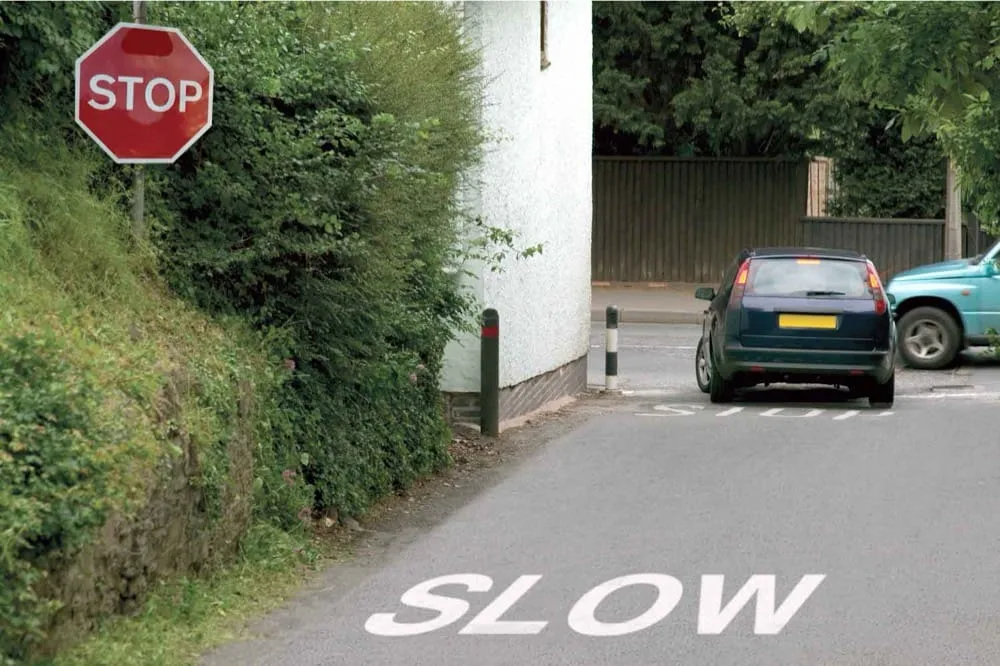
Only stop if you're turning to the right
Stop beyond the line at a point where you can see clearly
Only stop if there's traffic on the main road
Stop behind the line, then edge forward to see clearly
Show the answer
Stop behind the line, then edge forward to see clearlyThis was the right answer
At blind junctions, there's often a 'stop' sign. The 'stop' sign has been put there because the view into the main road is poor. You must stop because it won't be possible to assess the situation on the move, however slowly you're travelling.
What should you do if a driver comes out of a side road, causing you to brake hard?
Ignore the error and stay calm
Flash your headlights to show your annoyance
Sound your horn to show your annoyance
Overtake as soon as possible
Show the answer
Ignore the error and stay calmThis was the right answer
If a driver makes a mistake and emerges from a side road into your path, you should show tolerance and not react aggressively. If you're shaken or upset by the experience, slow down and - if necessary - stop in a convenient place. Take a break until you can safely continue on your journey.
You're driving in a town and want to turn left at a junction. What should you do if pedestrians are crossing at the junction?
Drive on, giving them plenty of room
Stop and wave at them to cross
Sound your horn and proceed
Give way to them
Show the answer
Give way to themThis was the right answer
If you're turning into a side road, pedestrians already crossing the road have priority and you should give way to them. Don't
• wave them across the road
• sound your horn
• flash your headlights
• give any other misleading signal - other road users may misinterpret your signal and you might lead the pedestrian into a dangerous situation.
If a pedestrian is slow or indecisive, be patient and wait. Don't hurry them across by revving your engine.
More driving instructor topics
3 moreEvery question in this bank sits in one of these, and each one is a page like this.